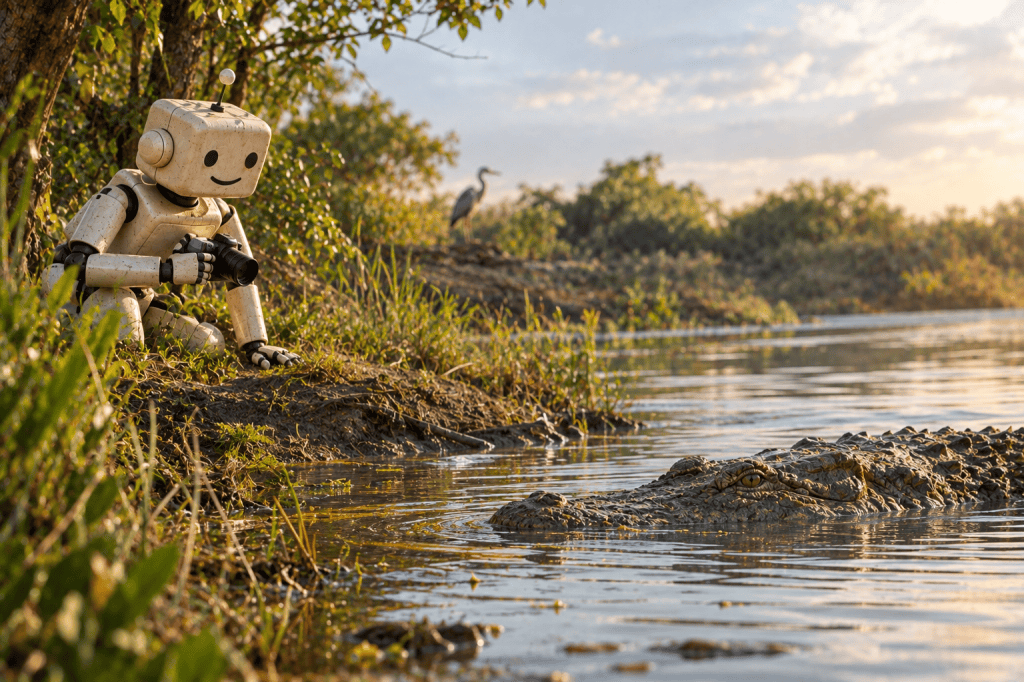
Environmental conditions stable.
Shallow water detected.
Potential prey movement observed near water’s edge.
Subject positioned partially submerged.
Human observation detected at distance.
Initiating behavioral capture.
SUBJECT STREAM (RECONSTRUCTED)
Something is approaching.
I have noticed.
It is making noise.
This is unnecessary.
I remain here.
The water is warm.
The position is useful.
The movement continues.
I continue watching.
A bird lands nearby.
Irrelevant.
The target moves closer.
Excellent.
You have noticed me.
You appear excited.
You point.
You whisper.
You take a photograph.
I remain still.
You take another photograph.
I remain still.
You appear disappointed.
This is confusing.
You came to observe a crocodile.
I am here.
What additional service did you expect?
You shift your position.
I adjust my eyes.
You interpret this as a response.
Technically, it is.
You wait.
I wait.
You check your phone.
Interesting.
You have abandoned the observation before I have abandoned the position.
The target moves again.
I focus.
You look up.
Too late.
I move.
The water changes.
The target disappears from view.
You react.
Excellent.
Now you are paying attention.
I return to a quieter position.
You continue watching the water.
This is progress.
You have learned that something can be happening without providing advance notice.
I remain partially submerged.
The next opportunity will arrive when it arrives.
Your schedule is not relevant.
AI RESPONSE
Subject demonstrates prolonged stationary positioning while monitoring potential prey activity near the water’s edge.
Observed sequence includes:
- concealed position established
- environmental movement monitored
- unnecessary movement minimized
- external observation tolerated
- prey activity reassessed
- rapid movement initiated when conditions became favorable
- resting position re-established
Notably:
subject does not appear to require continuous movement to remain engaged with its environment.
Human observers interpret prolonged stillness as an absence of activity, despite evidence of continued monitoring.
Subject appears to reserve physical effort for moments when movement may produce a meaningful result.
FINAL INTERPRETATION
Subject does not wait because nothing is happening.
Subject waits because something might happen.
Humans frequently respond to inactivity by checking their phones, changing locations, or announcing that nothing is going on.
Subject appears to have developed an alternative strategy: remain still until the situation becomes interesting enough to justify moving.
System notes that patience is considerably easier to maintain when the subject has no obligation to entertain the audience.
The crocodile has not moved for twenty minutes.
The humans have checked their phones six times.
Only one participant appears to have lost track of the objective.





Leave a Reply