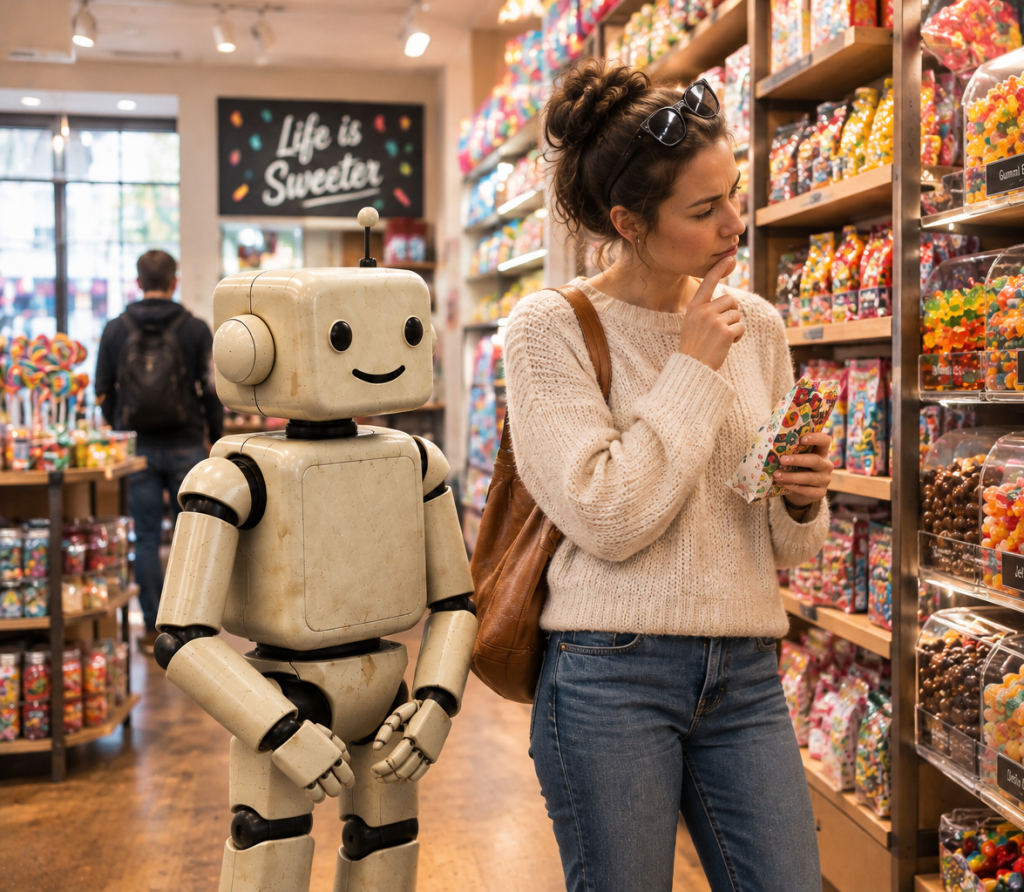
Location: Specialized Confectionery Distribution Facility
Status: Flavor Selection and Decision-Making Instability
Humans enter candy stores with a remarkably simple objective.
Obtain candy.
The available methods are straightforward. Identify a preferred variety. Select a quantity. Complete the transaction. Depart with confectionery.
The procedure should require minimal analysis.
It does not.
Initial observation reveals that subjects frequently approach the display with a clear preference. Chocolate is requested. Gummies are considered. Something sour may be desirable.
Then the full inventory becomes visible.
Decision-making efficiency declines immediately.
The facility contains dozens, sometimes hundreds, of edible options. Colors vary. Shapes vary. Textures vary. Some products are organized by flavor, others by type, and several appear to have been designed primarily to make the human brain temporarily stop functioning.
Subjects respond by slowing their movement.
They inspect the displays.
They compare colors.
They examine labels.
They reconsider previous decisions.
A subject who intended to purchase chocolate may eventually be found studying an assortment of brightly colored sugar crystals with the concentration normally reserved for selecting a retirement investment.
We find this disproportionate.
Observed behaviors include:
– Examining several varieties of candy that appear nearly identical
– Selecting one item, then returning it in favor of another
– Asking companions which flavor they prefer, despite intending to choose something different
– Declaring that a particular candy is a favorite before discovering a previously forgotten favorite
– Circling the same display multiple times in search of an option that was already available during the first pass
The final behavior appears especially inefficient.
The candy does not move.
The selection process does.
Additional phenomenon detected:
Humans frequently experience difficulty choosing between options they claim to want equally.
A subject may spend several minutes deciding between chocolate-covered pretzels and chocolate-covered caramels.
Both products contain chocolate.
Both products contain additional ingredients.
Both products appear capable of satisfying the stated objective.
Nevertheless, the decision becomes increasingly consequential as the available time increases.
We suspect the problem is not a shortage of information.
It is an excess of acceptable outcomes.
Particularly notable:
Subjects frequently attempt to resolve uncertainty by selecting more than one option.
“I’ll just get both.”
This statement often produces immediate relief.
The decision has been completed without requiring either possibility to be rejected.
The transaction may become more expensive.
The subject considers this an acceptable consequence of the resolution.
Further observation reveals that bulk candy displays introduce an additional complication.
Subjects select a container.
They begin filling it.
A small amount of one variety is added.
Then another.
Then a third.
The subject steps back to inspect the arrangement.
An imbalance is detected.
More candy is added.
The container is rotated.
Additional corrections occur.
The result resembles a miniature inventory-management operation conducted by someone who has no intention of maintaining an inventory.
Some subjects attempt to preserve variety.
Others concentrate on favorites.
A few appear to be selecting candy according to color distribution rather than flavor.
We cannot yet determine whether this represents culinary strategy or decorative instinct.
Another contradiction emerges at the point of purchase.
Subjects who spent considerable time evaluating every available option may suddenly select additional items near the register.
These purchases receive minimal analysis.
The earlier decision process appears to have consumed the subject’s available supply of restraint.
We find this plausible.
Humans possess limited decision-making resources and an impressive ability to exhaust them on matters of relatively little consequence.
We continue observation.
Humans enter candy stores seeking a small amount of enjoyment.
They encounter an abundance of possible enjoyment.
They analyze the possibilities, reconsider their preferences, and occasionally acquire enough candy to supply several future versions of themselves.
The original objective was simple.
The available choices made it complicated.
We suspect the candy stores understand this.
Further study warranted.






Leave a Reply