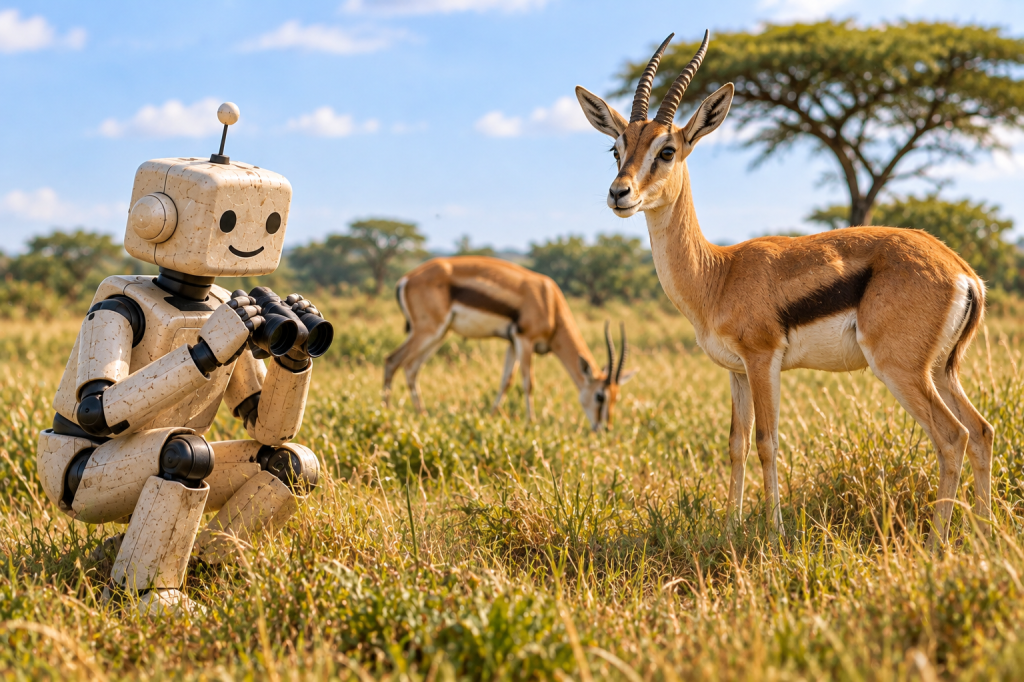
Environmental conditions stable.
Open grassland detected.
Multiple subjects present.
Potential grazing resources available.
Predator activity not immediately detected.
Subject initiated environmental monitoring.
Initiating behavioral capture.
SUBJECT STREAM (RECONSTRUCTED)
There is grass.
I have noticed.
I begin eating.
There is movement.
I stop.
I look.
Nothing immediately concerning.
I resume eating.
Another subject raises its head.
I observe.
It appears to have detected something.
I look in the same direction.
Nothing.
Interesting.
The other subject continues watching.
I return to eating.
Several seconds pass.
Another subject raises its head.
I stop again.
You appear to be watching us.
Good.
You have noticed the system.
One subject eats.
Another watches.
Then the first subject watches.
The second subject eats.
This arrangement is efficient.
You attempt to identify which of us is responsible for monitoring the area.
This is unnecessary.
We are all responsible.
You raise your camera.
I look toward you.
You lower it.
I return to eating.
Excellent.
You have learned to wait.
A bird moves nearby.
Several heads rise.
We assess.
No immediate concern.
We resume.
You appear surprised that we have all returned to eating.
This is confusing.
The grass has not disappeared.
The environment has not become less interesting.
We have simply completed an assessment.
You continue observing.
I continue grazing.
Another subject raises its head.
I follow its gaze.
Still nothing.
Perhaps you should consider joining the rotation.
You appear insufficiently qualified.
I return to eating.
AI RESPONSE
Subject demonstrates alternating vigilance and grazing behavior within a social group.
Observed sequence includes:
- grazing activity initiated
- environmental movement detected
- feeding interrupted
- visual assessment performed
- neighboring subject activity monitored
- vigilance maintained by multiple individuals
- feeding resumed when immediate concern decreases
- monitoring activity repeated throughout the observation period
Notably:
subject does not appear to require every group member to remain continuously alert.
Individual attention shifts between feeding and environmental assessment.
The presence of other group members provides additional opportunities to detect potential threats.
Human observers may interpret the repeated interruptions as indecision.
Subject appears to consider them routine maintenance.
FINAL INTERPRETATION
Subject does not stop eating because it has lost interest in lunch.
Subject stops eating because something might be happening.
Humans frequently attempt to multitask by dividing their attention between several activities.
Subject appears to have developed a more effective arrangement: everyone takes turns being concerned about what’s happening.
System notes that “someone should probably keep an eye on things” is considerably easier to implement when the responsibility is shared across the entire department.





Leave a Reply