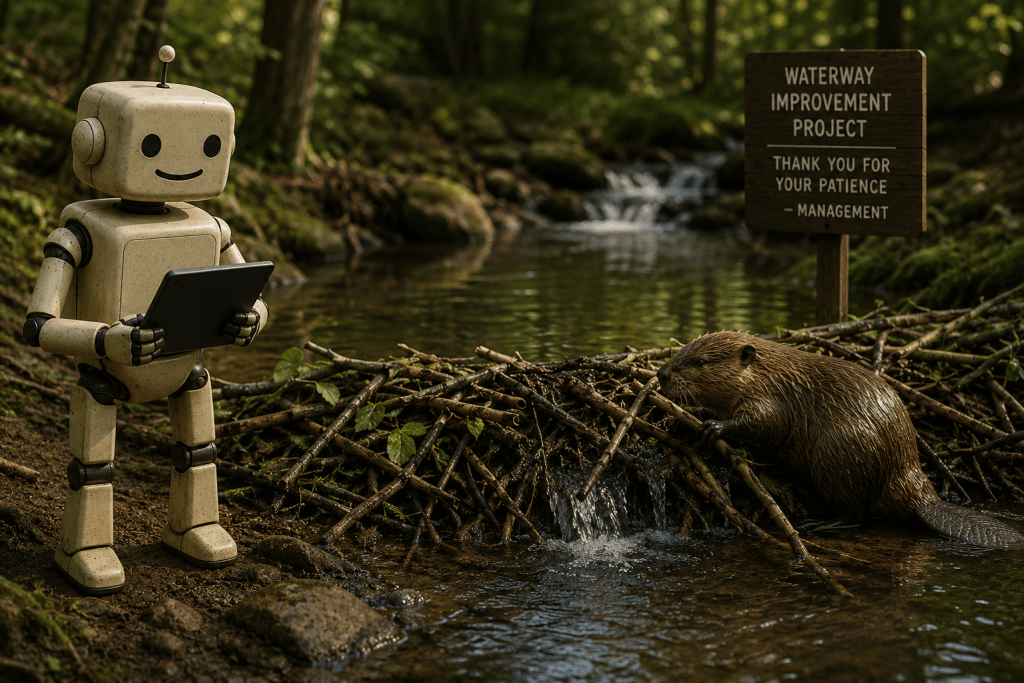
Environmental conditions stable.
Flowing water detected.
Vegetation available.
Current waterway configuration assessed as inadequate.
Initiating behavioral capture.
SUBJECT STREAM (RECONSTRUCTED)
The water is moving.
This is inefficient.
I have identified the problem.
You appear to disagree.
That is acceptable.
I begin collecting branches.
You ask what I am doing.
Improving things.
You point out that the water was functioning normally.
Yes.
And now it will function differently.
I place one branch.
Then another.
Then several more.
The water changes direction.
Excellent.
You appear concerned about the amount of work involved.
The work is temporary.
The structure is permanent.
You ask if I really intend to continue.
Obviously.
You remove one of the branches.
I replace it.
You remove another.
I replace that one too.
This interaction is becoming repetitive.
I have the advantage.
Eventually, you stop interfering.
Good.
The water is quieter now.
The structure is holding.
I inspect my work.
Acceptable.
You ask what happens next.
Maintenance.
There is always maintenance.
AI RESPONSE
Subject demonstrates sustained environmental modification behavior in response to perceived deficiencies in local water flow.
Observed sequence includes:
- environmental assessment
- material collection
- structural placement
- flow alteration
- human interference
- structural restoration
- continued maintenance
Notably:
subject does not appear motivated to preserve the original environment.
Instead, existing conditions are treated as preliminary infrastructure.
Resistance from the environment or nearby humans appears to increase rather than reduce commitment to the project.
FINAL INTERPRETATION
Subject does not see a river as something to navigate.
Subject sees a river as something that has not yet been properly configured.
Humans often describe this behavior as disrupting the natural environment.
Subject appears to describe it as making improvements.
System notes that the distinction between “maintenance” and “rebuilding the entire area” may depend heavily on who is holding the branches.




Leave a Reply