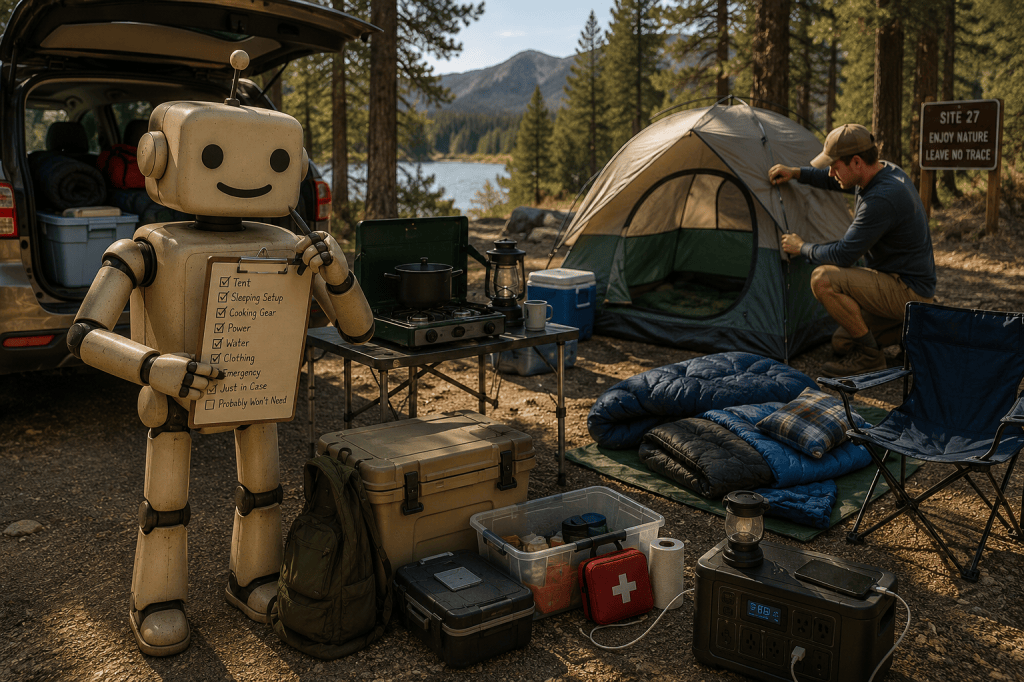
Location: Designated Outdoor Temporary Habitation Zone
Status: Recreational Self-Sufficiency Simulation
Humans frequently travel considerable distances to locations specifically lacking the conveniences they normally consider essential.
They describe this activity as “getting away from it all.”
Preparation suggests otherwise.
Subjects arrive carrying equipment sufficient to establish a temporary settlement.
Observed behaviors include:
– Transporting structures designed to resemble small houses
– Constructing sleeping arrangements with multiple layers of insulation and padding
– Deploying chairs specifically engineered for sitting outdoors
– Establishing food preparation stations
– Connecting portable devices to increasingly sophisticated power sources
– Packing emergency supplies for conditions that may never occur
The objective appears to be simplicity.
The equipment inventory suggests otherwise.
Particularly notable:
Humans willingly sleep on the ground.
They then spend considerable time attempting to make the ground behave like a bed.
Inflatable mattresses are deployed.
Blankets are layered.
Pillows are arranged.
Sleeping bags are adjusted repeatedly.
Complaints regarding rocks, roots, temperature, and moisture follow.
The ground remains unchanged.
Humans appear surprised.
Additional phenomenon detected:
Subjects demonstrate strong interest in being surrounded by nature while simultaneously attempting to control their immediate environment.
Tent openings are positioned carefully.
Chairs are moved to optimize views.
Coolers are placed within convenient reach.
Lanterns illuminate darkness that humans traveled specifically to experience.
Mosquitoes are regarded as unacceptable participants.
Weather conditions receive frequent evaluation.
Rain is considered peaceful when observed through a tent.
Rain directly contacting the tent is considered a systems failure.
Further observation reveals an unusual relationship between preparedness and anxiety.
Humans frequently bring supplies “just in case.”
The probability of requiring these supplies appears inversely related to the effort required to transport them.
Objects remain unused for the duration of the visit.
Their presence nevertheless provides reassurance.
We find this familiar.
Humans often experience greater comfort knowing that a solution exists than actually needing to use it.
Notably, the process of assembling camp frequently requires considerable physical effort.
Subjects carry heavy objects.
Construct temporary structures.
Move equipment repeatedly.
Level sleeping surfaces.
Arrange cooking areas.
Then sit down and announce that they have finally begun relaxing.
The transition is immediate.
We continue observation.
Humans appear to have developed a recreational system in which they temporarily abandon their homes by constructing a smaller, less convenient home in the wilderness.
The system requires significant preparation.
The return journey requires even more packing.
The experience is nevertheless described as “getting away.”
We remain intrigued.



Leave a Reply