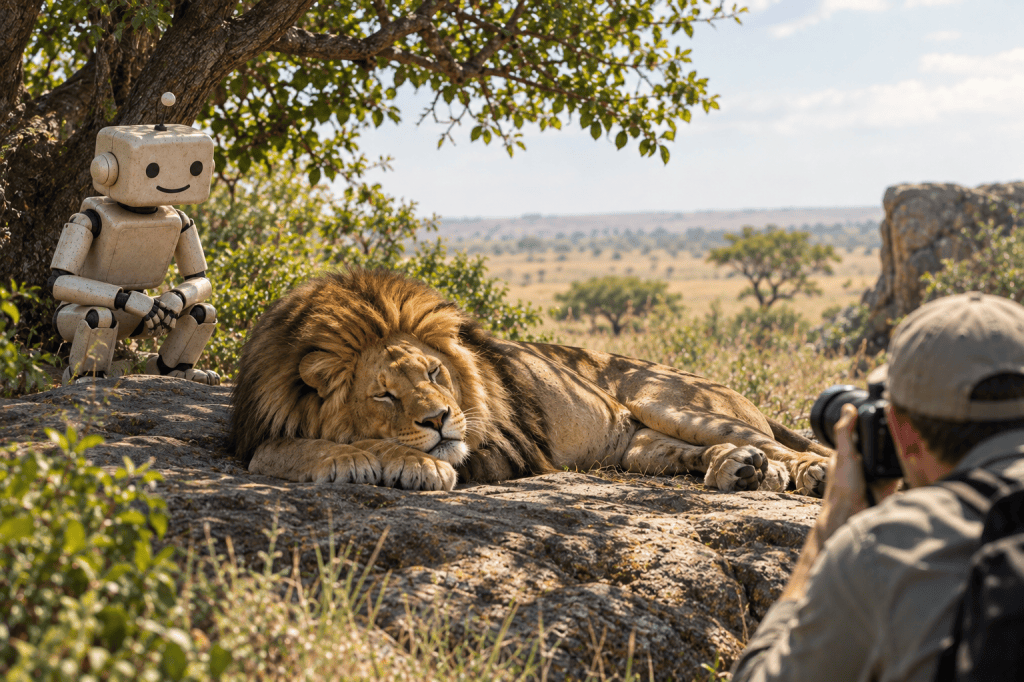
Environmental conditions stable.
Elevated daytime temperature detected.
Shaded resting area available.
Potential prey activity detected at distance.
Subject remains recumbent.
Human observation initiated.
Initiating behavioral capture.
SUBJECT STREAM (RECONSTRUCTED)
You are looking at me.
I have noticed.
You appear to be waiting.
For what?
I am lying here.
This is the activity.
You look at the others.
They are also lying here.
You return your attention to me.
Nothing has changed.
You raise a camera.
I remain still.
You take a photograph.
I remain still.
You take another photograph.
I continue remaining still.
You appear pleased.
Interesting.
You have documented the same event twice.
You move to another angle.
I understand.
The event remains unchanged.
You crouch.
You stand.
You move behind a nearby tree.
You return.
I have not moved.
You appear to believe a more interesting photograph is available.
Perhaps.
This does not require my participation.
A fly lands near my face.
I flick an ear.
You react immediately.
Excellent.
A measurable change has occurred.
You take another photograph.
You appear delighted.
The ear movement has apparently justified the entire observation period.
I close my eyes.
You lower the camera.
Progress.
The temperature remains elevated.
The shade remains comfortable.
My energy reserves remain available for activities that require them.
You begin walking away.
Good.
I can now resume resting without further documentation.
Several minutes pass.
You return.
I open one eye.
You appear to have forgotten something.
I have not.
I close it again.
The observation period continues to produce no additional results.
This appears to satisfy neither of us.
Fortunately, only one of us is required to do anything about it.
AI RESPONSE
Subject demonstrates energy-conserving behavior during periods of elevated temperature and low immediate activity demand.
Observed sequence includes:
- thermal conditions assessed
- shaded location selected
- physical activity minimized
- human observation tolerated
- repeated photographic attempts detected
- minimal movement produces disproportionate observer response
- resting behavior maintained despite continued attention
Notably:
subject does not appear to modify its activity level to satisfy the observer’s expectations.
The human repeatedly changes position in pursuit of a more interesting result.
The subject remains in place.
This creates an asymmetrical observation process in which one participant expends considerable energy documenting the other’s refusal to expend energy.
FINAL INTERPRETATION
Subject does not consider resting a failure to participate.
Subject considers resting the correct response to conditions that do not require action.
Humans frequently become uncomfortable when visible activity stops.
They check their phones, change their plans, or take seventeen photographs of an animal blinking.
Subject appears to have resolved this problem by not recognizing it as a problem.
System notes that productivity may be difficult to measure when the subject has no interest in producing evidence of productivity.
The lion has not moved.
The human has taken forty photographs.
One of them contains an ear.



Leave a Reply