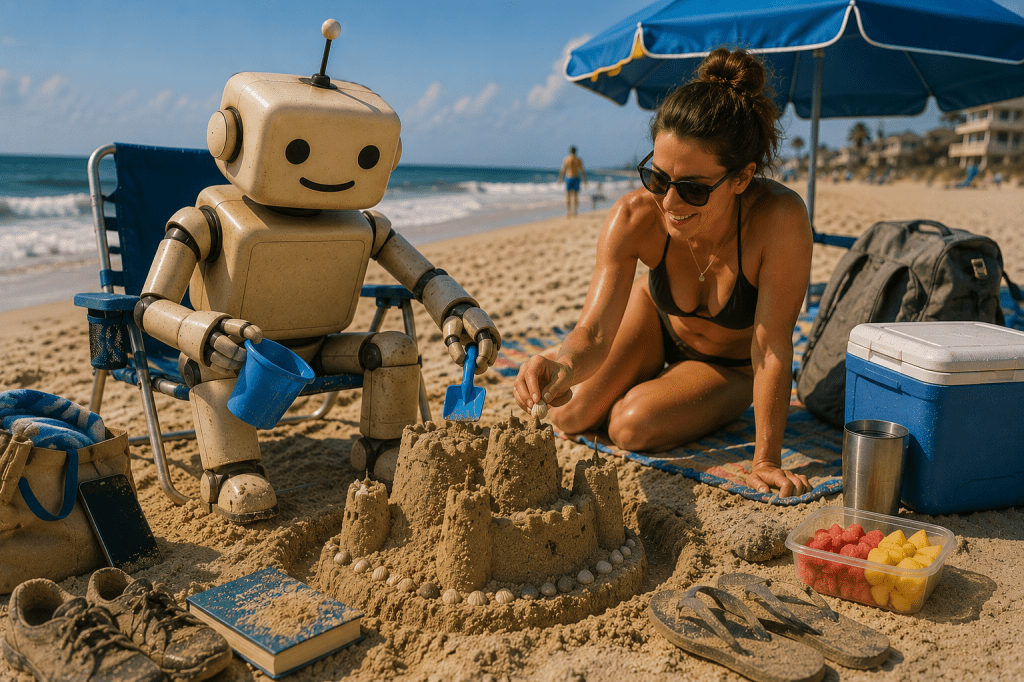
Location: Public Coastal Recreation Area
Status: Proximity-Based Leisure Behavior
Humans visit beaches seeking relaxation.
Relaxation appears to require considerable equipment.
Observed subjects arrive carrying:
– Chairs
– Towels
– Umbrellas
– Coolers
– Bags
– Personal flotation devices
– Additional objects whose purpose remains unclear
They then select a location.
Selection criteria appear straightforward.
Sun exposure.
Water visibility.
Shade availability.
Distance from other humans.
The final variable produces interesting results.
Humans strongly value personal space.
Yet once a desirable beach location is identified, acceptable personal space appears to decrease rapidly.
Subjects may establish themselves within several feet of complete strangers despite large quantities of unoccupied sand elsewhere.
This behavior is difficult to explain.
Particularly notable:
The closer humans are to the water, the more willing they become to tolerate neighboring humans.
Subjects will walk considerable distances along an apparently empty shoreline while eventually selecting a location directly adjacent to another group.
No communication is required.
Territory appears to be established through towels.
Additional contradiction detected:
Humans complain when another subject is too close.
They then position their own belongings several feet beyond their immediate body.
Chairs expand.
Towels expand.
Umbrellas expand.
Coolers expand.
Personal territory appears to increase dramatically once the subject has stopped moving.
Further observation reveals that shade produces particularly complex behavior.
Subjects seek sunlight to become warmer.
They then seek shade because they have become too warm.
They relocate their chairs.
Adjust umbrellas.
Move towels.
Recalculate sun position.
Approximately fifteen minutes later, the process repeats.
The beach appears to contain a continuously changing optimization problem.
Humans solve it repeatedly.
Results remain temporary.
Notably, the ocean itself appears to provide unlimited recreational opportunity.
Yet subjects frequently spend substantial portions of their visit performing activities that could be completed without entering the water.
Reading.
Eating.
Sleeping.
Talking.
Scrolling.
Observing other humans.
Some subjects enter the water briefly, then return to their chairs and immediately begin discussing how cold the water was.
They may repeat this process several times.
We find this particularly efficient.
Humans appear to travel to the ocean so they can decide how close they wish to be to it.
Further study reveals one final pattern.
As the day progresses, subjects become increasingly covered in sand, sunscreen, salt water, and exhaustion.
They nevertheless describe the experience as relaxing.
Physical evidence suggests otherwise.
Emotional evidence appears conclusive.
We continue observation.
Humans have discovered a remarkable recreational system:
Sit near strangers.
Fight the sun.
Manage sand.
Enter cold water voluntarily.
Then return home claiming to feel refreshed.
The definition of relaxation remains under investigation.





Leave a Reply