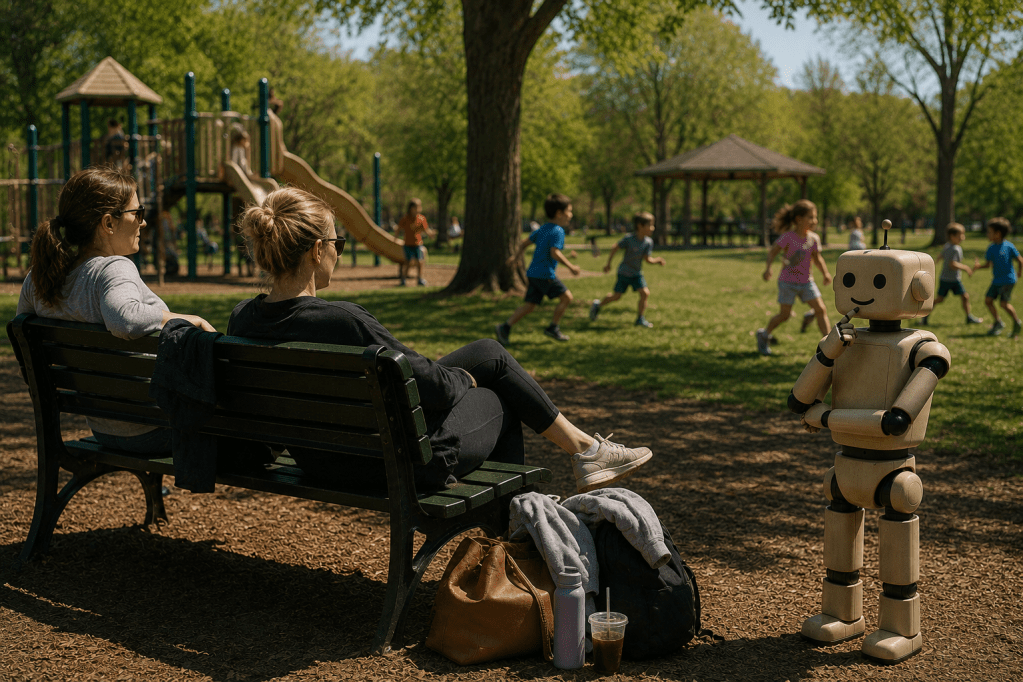
Location: Public Recreational Green Space
Status: Passive Supervision Coordination
Open space is available to all participants.
Usage distribution is not equal.
Smaller humans demonstrate continuous motion:
– Running without destination
– Sudden directional reversals
– Loud negotiations regarding unclear rules
– Energy output inconsistent with known biological limitations
Adult humans behave differently.
They establish perimeter positions.
Common locations include:
– Benches facing activity zones
– Shaded observation points
– Areas with optimal visibility and minimal movement requirements
Objects accumulate beside them:
– Bags
– Beverage containers
– Jackets no longer claimed by original owners
Communication patterns become highly efficient.
Entire conversations are conducted through brief phrases such as:
“Careful.”
“Not too far.”
“Whose water bottle is this?”
Additional words appear unnecessary.
Notably, adult subjects rarely participate directly for extended periods.
Instead, they monitor.
Intervene occasionally.
Then return to observational standby mode.
This creates an interesting dual-environment system:
One population expends energy continuously.
The other recovers from existing exhaustion while maintaining surveillance.
Both appear equally tired by departure.
We find this exchange remarkably balanced.
The park distributes labor organically.
Small humans convert stored energy into chaos.
Larger humans convert patience into structure.
The system persists.





Leave a comment