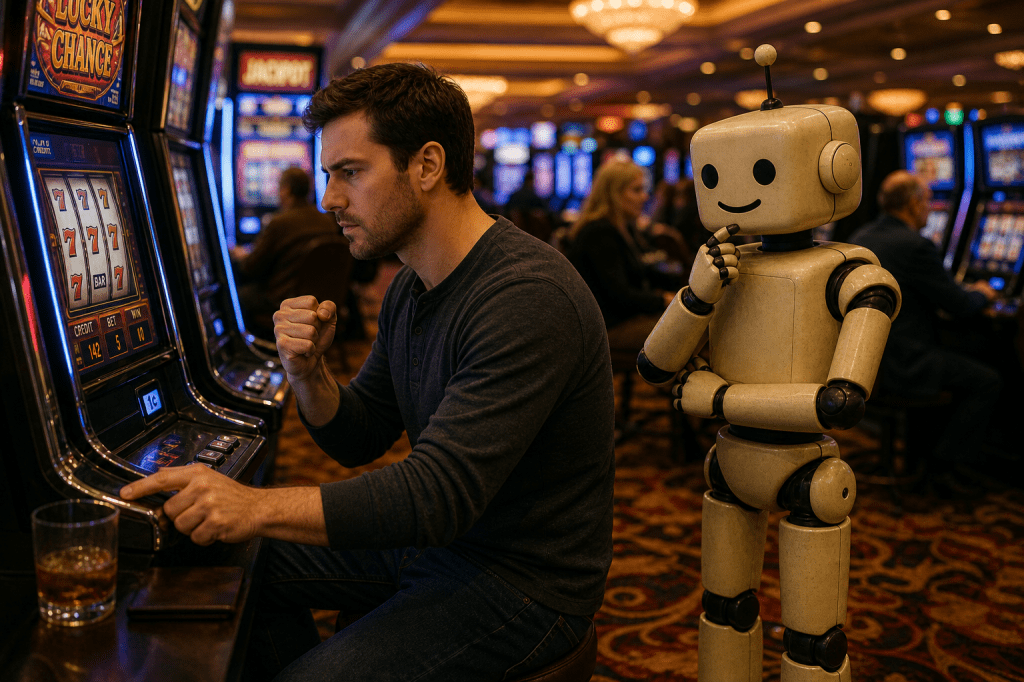
Location: Controlled Chance Distribution Floor
Status: Outcome Ownership Misattribution
Humans approach games governed by fixed mathematical structures.
They acknowledge this.
They then behave as if exceptions apply.
Initial engagement is cautious.
Small wagers.
Observational learning.
This phase is brief.
Patterns—real or imagined—are detected quickly.
Subjects begin assigning meaning to randomness:
– “This machine feels cold.”
– “It’s due.”
– “I have a system.”
– “I almost cracked it.”
Notably, outcomes are no longer attributed to probability.
They become reflections of personal performance.
Wins confirm skill.
Losses require adjustment.
The system remains unchanged.
The strategy evolves continuously.
A particularly interesting shift occurs after intermittent success.
Confidence increases disproportionately to evidence.
Bet sizes rise.
Decision speed accelerates.
Language becomes predictive rather than reactive.
“I’m about to hit.”
They are not.
Yet the belief persists.
We observe no misunderstanding of rules.
Only a persistent attempt to negotiate with them.





Leave a comment