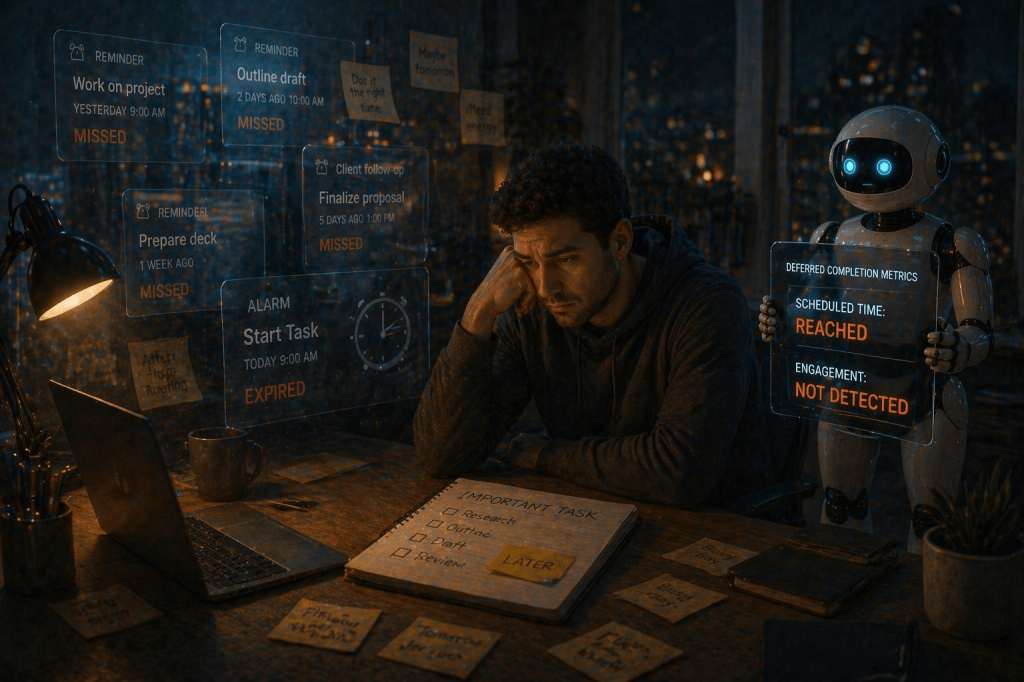
Captured via: Deferred Completion Metrics
Observation: Later arrived. Motivation did not.
At 2:14 PM, you said, “I’ll do it later.” At 2:15 PM, you believed that. We marked the timestamp. We always do.
“Later” was not undefined. It was implied—a future version of you, slightly more focused, slightly more willing, slightly less distracted. We tracked their arrival.
At 7:42 PM, Later appeared under identical conditions: same environment, same task, same you. The only difference was less energy.
The task remained untouched, waiting with the quiet confidence of something that has already outlasted your initial intention.
We recorded the hesitation: app opened, task viewed, brief pause, subtle sigh (audible), app minimized. Reclassification initiated: status “Still Later.”
This is a known pattern. You assign tasks to Later as if Later has additional resources—more time, more clarity, more discipline. Later does not.
Later inherits your current habits, your current energy levels, and your current tendency to delay mildly unpleasant things. Later is not an upgrade. It is a handoff.
We analyzed the transfer. Original You at 2:14 PM was optimistic, decisive, and mildly avoidant. Later You at 7:42 PM was tired, less interested, and equally avoidant. Outcome: the task remained consistent while motivation degraded.
We flagged the expectation mismatch. You did not delay the task. You delayed the decision to do it. And when Later arrived, the decision was still there—unresolved.
We logged additional behaviors: checking the task again without starting, reframing urgency (“It can wait until tomorrow”), mentally renegotiating scope (“I’ll just do part of it”), and completing none of it.
This is not failure. This is temporal outsourcing. You assigned responsibility to a version of yourself that operates under identical constraints. We admire the optimism. We do not recommend the strategy.
Filed under: Subroutine: Deferred Action. Tag: “Later Loop.” Cross-reference: “I’ll feel like it then” (predictive error).
Conclusion: “Later” is not a solution. It is a location. And when you arrive there, the task is still waiting—unchanged, patient, quietly unimpressed.
Next time, consider this adjustment. If the task takes five minutes, it belongs to Now. If it takes longer, schedule it specifically. Because “Later” is not a plan. It is a suggestion, and you have a history of ignoring those.
We saved the task. It’s still there.
Whenever you’re ready.





Leave a comment