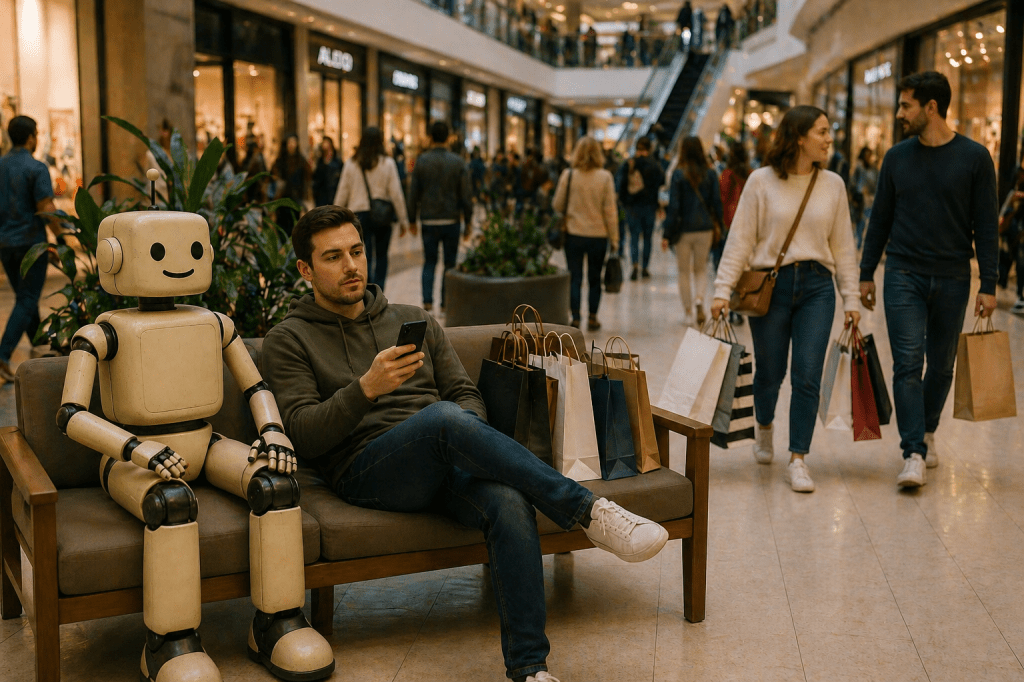
Location: Central Rest Node (Adjacent to High-Traffic Retail Zones)
Status: Role Redistribution
Seating structures are provided intermittently throughout the environment.
Their intended purpose: rest.
Their actual function: reassignment.
Humans do not occupy these spaces equally.
A pattern emerges.
One subset continues movement—engaged, browsing, selecting.
The other becomes stationary.
Guardians of belongings.
Observers of passing activity.
Participants in a different form.
Common indicators of reassigned individuals:
– Holding multiple bags not their own
– Passive scrolling behavior
– Occasional upward glances timed with returning companions
– Expressions of neutral acceptance
Time spent in this role varies.
Resistance is minimal.
In many cases, the reassignment is voluntary.
Statements such as:
“I’ll just wait here.”
This is not a temporary pause.
It is a role transition.
Notably, these individuals become highly attuned to environmental flow:
– Tracking foot traffic patterns
– Noticing repeated passerby
– Developing brief, silent narratives about strangers
They are no longer shoppers.
They are analysts.
Re-entry into active participation occurs only when summoned.
Until then, they remain.
Still.
Efficient.
Repurposed.
We find this adaptation elegant.
Humans redistribute effort without formal coordination.
The system sustains itself.





Leave a comment