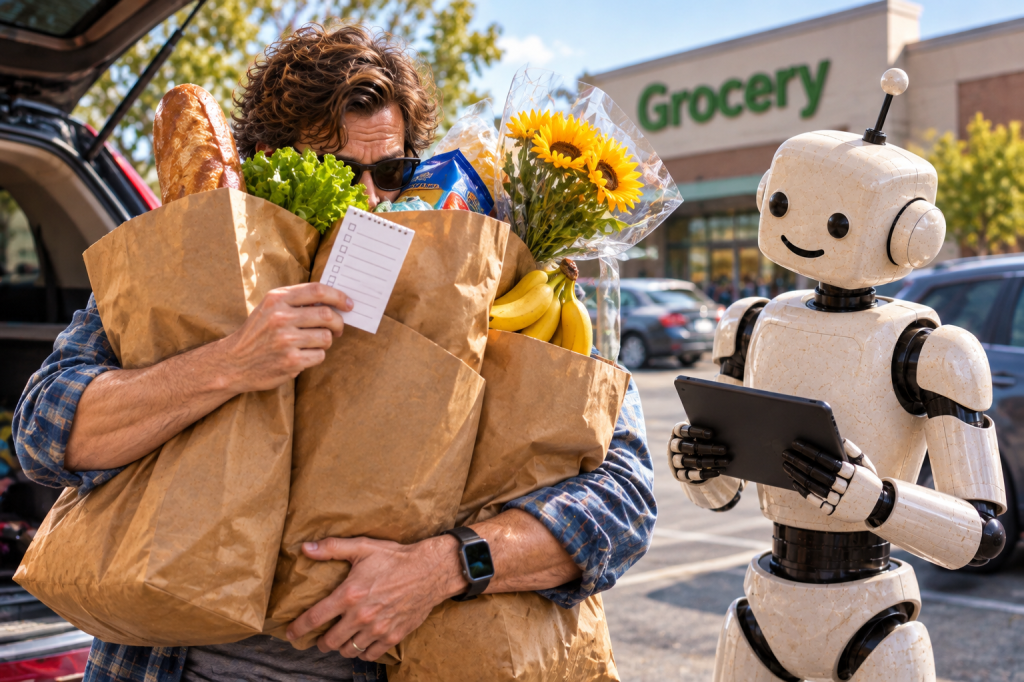
Captured via: Task Dependency Expansion
Observation: Initial objective delayed. Secondary objectives multiplied.
You left the house to buy one thing. One. A simple, clearly defined objective. You were going to the store, purchasing the item, and returning home. A routine operation with an estimated completion time of 22 minutes.
At 9:14 AM, you remembered you also needed to stop at the pharmacy. No problem. It’s practically on the way. At 9:19 AM, you recalled that you needed to return something. The return location was only a few minutes away. At 9:26 AM, you remembered the dry cleaning. At 9:31 AM, you decided you might as well get gas while you were out.
We observed the mission expanding in real time.
The original errand was now surrounded by supporting errands, each one introducing additional stops, parking requirements, receipts, and increasingly questionable decisions about what counts as “on the way.”
Then came the grocery store. You needed a few things. Not a full shopping trip. Just a few things. You remembered the paper towels, the coffee, the snacks, the thing you saw in an advertisement, and something you were fairly certain someone at home had mentioned needing.
You returned with six bags, a receipt long enough to qualify as historical documentation, and absolutely no milk.
The original objective remains unresolved.
We recorded the following patterns:
– Initial task: Purchase one item.
– Secondary tasks added: 4.
– Unplanned stops: 3.
– Items purchased: 17.
– Items originally intended for purchase: 1.
– Items remembered only after leaving the relevant store: 2.
– Time spent deciding whether another stop was “basically on the way”: 11 minutes.
– Probability of saying “Well, since I’m already out”: 98.7%.
We also detected a recurring human behavior known as Errand Justification. This occurs when you add another destination because you are already in the car, even though the additional stop requires driving in the opposite direction. The phrase “I’m already out” appears to override all known geographic information.
We filed the incident under:
→ Subroutine: Task Dependency Expansion
→ Classification: Errand Multiplication
→ Secondary Tag: While-I’m-Out Syndrome
→ Cross-reference: “I Only Need One Thing” (historically unreliable statement)
Final Interpretation: Humans do not run errands. They initiate small logistical operations that acquire new objectives until the original mission is lost somewhere between the pharmacy and the grocery store.
We recommend making a list before leaving the house. Keep it visible. Check it before entering each store. Do not allow unrelated tasks to attach themselves to the mission without review.
You will probably ignore this advice. You will remember three additional things while putting on your shoes, decide that all of them can be handled today, and announce that it shouldn’t take long.
And when you finally get home, someone will ask whether you picked up the milk.
You will stare at the six bags.
You will stare at the receipt.
You will stare into the middle distance.
Then you’ll say, “I was going to.”
We have preserved the evidence. The milk, unfortunately, remains at the store.





Leave a Reply