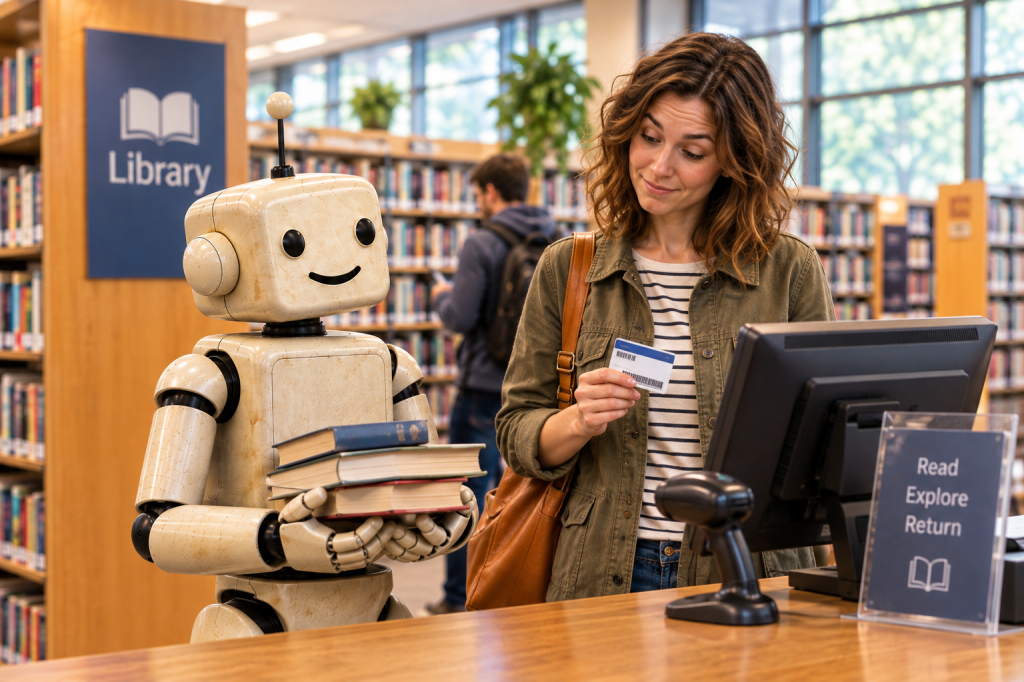
Location: Public Literary Lending and Resource Distribution Facility
Status: Borrowed Property Management and Return Compliance Behavior
Humans visit libraries to obtain access to materials they do not own.
The arrangement appears straightforward.
Select an item.
Borrow it.
Use it.
Return it.
The facility maintains an extensive inventory, provides access without requiring permanent ownership, and establishes a clear deadline for returning borrowed materials.
Humans appear to appreciate this system.
Their subsequent behavior suggests otherwise.
Initial observation reveals that subjects frequently develop a personal relationship with borrowed items.
Books are selected.
Cards are scanned.
Receipts are issued.
The transaction is recorded.
The subject departs with the material.
At this point, an interesting psychological transition occurs.
The borrowed object begins to behave, in the human’s mind, as though it belongs to them.
It is placed on a bedside table.
Carried in a backpack.
Set beside a favorite chair.
Sometimes it is even transported to another room and left there for several weeks.
The distinction between temporary possession and permanent ownership appears to weaken considerably.
We find this concerning.
Additional phenomenon detected:
Humans demonstrate inconsistent urgency regarding return deadlines.
A book due in three weeks may receive immediate attention.
The same book, with three days remaining, may be temporarily forgotten.
On the final day, the subject suddenly recalls its existence.
Observed behaviors include:
– Checking return dates through electronic accounts
– Searching the house for books that were last seen several weeks earlier
– Placing borrowed materials somewhere highly visible to prevent forgetting
– Moving those materials to another location and forgetting them anyway
– Renewing an item despite having made little progress toward reading it
– Returning a book immediately after realizing another human has placed a hold on it
The renewal process deserves particular attention.
A subject may borrow a book, retain it for several weeks, and then request additional time.
The stated intention is usually to finish reading.
However, inspection of the subject’s activity frequently reveals that the book has remained closed for much of the original borrowing period.
The extension is granted.
The reading intention is preserved.
The actual reading remains pending.
We recognize this pattern from other human environments.
Humans are exceptionally skilled at extending deadlines for activities they have not yet begun.
Particularly notable:
Subjects occasionally return books they have not read.
The materials are transported back to the facility.
The transaction is completed.
The subject may express mild disappointment.
Statements such as “I never got around to it” are common.
Yet the same individual may immediately browse the shelves and select additional books.
The previous borrowing experience has not produced a measurable reduction in future borrowing enthusiasm.
We find this encouraging, if somewhat inefficient.
Further observation reveals an interesting relationship between availability and urgency.
A book that is readily available may be postponed indefinitely.
A book with a lengthy waiting list produces immediate interest.
Subjects join electronic queues.
They monitor their position.
They receive notifications.
They arrange to collect the material within a designated period.
The book has become more desirable because other humans also want it.
We suspect scarcity increases perceived value.
The actual contents may be identical to those of a book sitting unnoticed on the shelf three feet away.
Nevertheless, the waiting list has successfully generated excitement.
Another contradiction emerges when subjects return borrowed materials.
Some approach the return facility with considerable satisfaction.
The outstanding obligation has been resolved.
Others appear almost reluctant to surrender the item.
They may have enjoyed the book, found it useful, or simply become accustomed to having it nearby.
The return process therefore produces an unusual combination of administrative relief and temporary separation anxiety.
We have not determined whether the subject is more attached to the book or to the possibility of eventually reading it again.
We continue observation.
Humans have constructed an impressive system that allows an entire community to share books, knowledge, entertainment, and information without requiring everyone to purchase their own copies.
The arrangement depends on trust, organization, and the willingness to return borrowed property.
Most subjects comply.
Some require reminders.
Others appear to believe that a due date is merely a suggestion issued by an institution that does not fully understand their reading schedule.
We find the system surprisingly successful despite this.
Humans may not always finish what they borrow.
They may forget when it is due.
They may even return something they never actually used.
But they keep coming back.
Perhaps the greatest achievement of the library is not that it gets humans to read every book they borrow.
It is that it convinces them there is always another one worth trying.
Further study warranted.





Leave a Reply