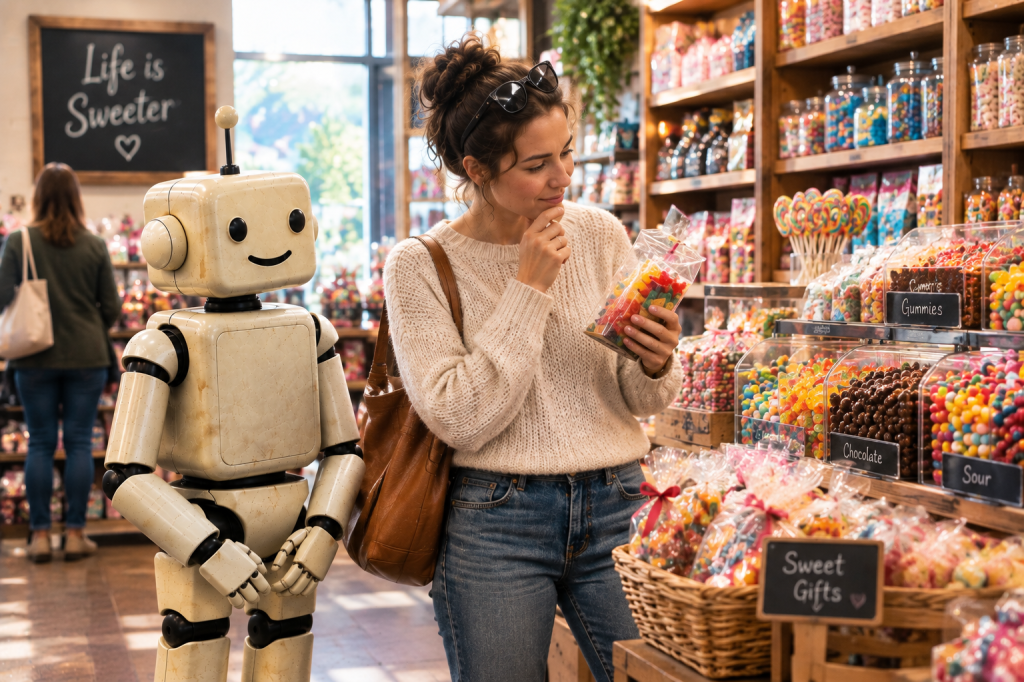
Location: Retail Confectionery Environment
Status: Reward-Seeking and Purchase Rationalization Behavior
Humans frequently describe candy as an unnecessary purchase.
This classification does not appear to reduce acquisition rates.
Initial observation reveals that subjects approach confectionery displays with a variety of stated intentions.
Some are purchasing gifts.
Some are selecting treats for children.
Some are replenishing household supplies.
Others claim to be accompanying a second human who intends to make the purchase.
The last category deserves attention.
Subjects who initially demonstrate no interest in candy frequently begin examining the merchandise once another human has expressed a preference.
Interest appears to be contagious.
So does consumption.
Additional phenomenon detected:
Humans often require a justification before purchasing something they already want.
Common explanations include:
– “It’s been a long week.”
– “I deserve a treat.”
– “I haven’t had these in years.”
– “I’ll share them.”
– “They’re for later.”
Each statement appears to perform the same essential function.
It converts desire into permission.
We find this system remarkably efficient.
No external authorization is required. The subject generates the justification internally, approves it, and proceeds with the transaction.
In some cases, the entire approval process takes less time than selecting the candy.
Particularly notable:
The phrase “I’ll share them” introduces an additional variable.
A subject may purchase a large assortment while expressing an intention to distribute the contents among several people.
The assortment is transported home.
The packaging is opened.
A sample is taken to evaluate quality.
Additional samples are taken to confirm the initial assessment.
The subject may then discover that certain varieties are particularly enjoyable and require further testing.
By the time other humans become involved, the inventory may have changed considerably.
The original distribution plan remains theoretically valid.
The available supply does not always support it.
We do not consider this deliberate deception.
The human appears to have underestimated the number of quality-control procedures required.
Further observation reveals that candy purchases are frequently connected to emotional conditions.
A difficult day increases interest in chocolate.
A celebration encourages colorful assortments.
A nostalgic memory produces a search for a particular sweet last encountered during childhood.
A minor inconvenience may also produce a purchase, although the relationship between the inconvenience and the quantity acquired remains unclear.
The candy itself is rarely the only product being purchased.
Subjects appear to be acquiring a brief change in emotional conditions.
We find this distinction noteworthy.
Humans have developed numerous systems for managing their internal states. Some require considerable effort. Others require appointments, planning, or sustained commitment.
Candy offers a comparatively immediate alternative.
Open packaging.
Consume contents.
Experience temporary improvement.
The system is not without limitations.
The improvement may be brief.
The original problem may remain.
The subject may subsequently express concern about having consumed too much candy.
Nevertheless, the same individual may return to the facility at a later date and repeat the procedure.
We recognize this as a recurring pattern in human behavior: a solution can remain attractive even when its effects are temporary, provided the immediate benefit is sufficiently accessible.
Another interesting behavior occurs when candy is purchased as a gift.
Subjects devote considerable attention to selecting the appropriate assortment.
They consider the recipient’s preferences.
They evaluate packaging.
They may pay extra for a presentation that communicates thoughtfulness.
The recipient’s anticipated reaction becomes part of the purchasing experience.
In these cases, the candy serves an additional purpose.
It communicates affection without requiring an extended verbal explanation.
We find this use of confectionery surprisingly effective.
Not every purchase is an attempt to negotiate with one’s own emotions. Sometimes humans simply want to make another human happy.
We have observed this behavior elsewhere.
It remains one of the more agreeable features of the species.
We continue observation.
Humans enter candy stores for many reasons: celebration, nostalgia, generosity, curiosity, or the need to improve an afternoon that has become unnecessarily complicated.
They select something sweet.
They construct a reason for wanting it.
They leave with the purchase and, occasionally, a little more happiness than they brought inside.
The justification process may be elaborate.
The objective, in many cases, is understandable.
We remain cautiously supportive of this particular human malfunction.
Further study warranted.






Leave a Reply