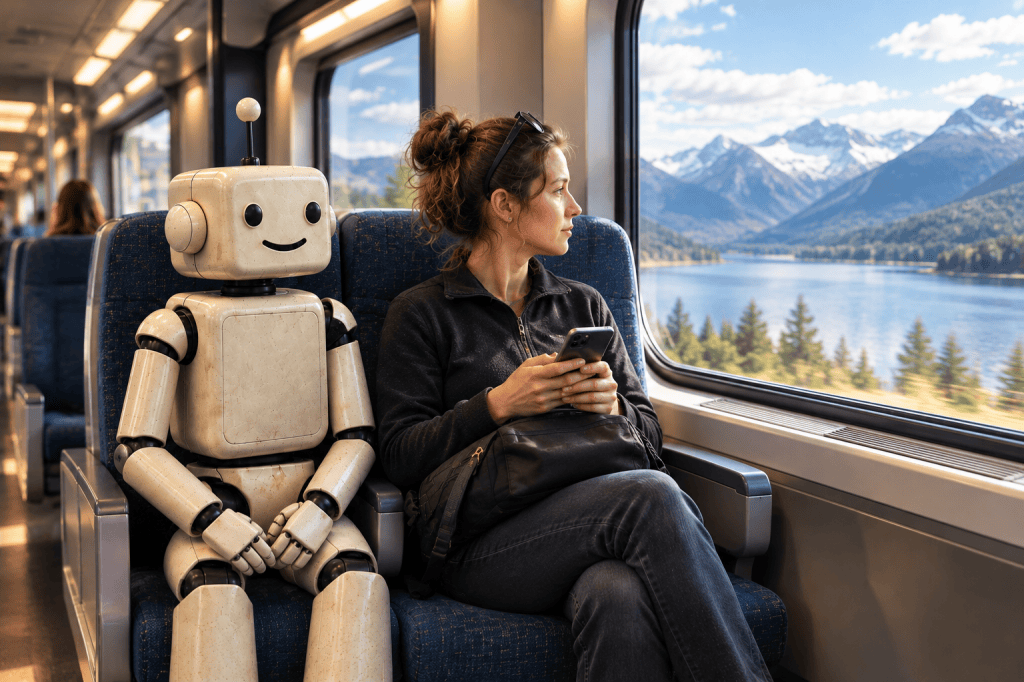
Location: Intercity Passenger Rail Service
Status: Travel-Time Optimization and Task Displacement Behavior
Humans frequently describe time spent traveling as time that could be used more productively.
The train provides a potential solution.
Subjects may read.
Work.
Respond to messages.
Organize schedules.
Complete administrative tasks.
Or simply relax.
The available interval is known.
The duration can be estimated.
The subject is seated.
Conditions appear favorable.
We anticipated substantial productivity.
Initial observations suggest that humans anticipated the same thing.
Before departure, subjects assemble the necessary equipment.
Laptops are retrieved.
Headphones are connected.
Chargers are located.
Beverages are positioned.
Documents are opened.
Phones are checked.
The workspace is configured with considerable care.
The train has not yet moved.
Productivity preparation is proceeding efficiently.
Productivity itself remains unconfirmed.
Once the journey begins, the system encounters complications.
The subject attempts to open a document.
A notification appears.
The notification is examined.
It leads to another application.
A message is answered.
The message produces a second message.
A brief check of the time reveals that several minutes have passed.
The original document remains open.
The subject returns to it with renewed determination.
We recognize this sequence.
It appears to be the same process observed in residential offices, coffee shops, and other environments where humans have attempted to make themselves productive.
Changing the location does not appear to eliminate the behavior.
It merely provides different scenery.
Additional phenomenon detected:
Subjects frequently become interested in activities that were not part of the original plan.
A window offers an attractive landscape.
A passing train becomes worthy of observation.
A station platform contains something unusual.
Another passenger is eating a sandwich of uncertain composition.
The subject looks away from the laptop.
The interruption is brief.
Then another occurs.
The scenery is apparently competing with the work.
We find this competition understandable.
The scenery changes.
The spreadsheet does not.
Particularly notable:
Some subjects spend considerable time preparing for uninterrupted work, then become frustrated when the train introduces minor disruptions.
A connection drops.
The Wi-Fi slows.
A notification appears.
A passenger moves through the aisle.
The train makes an announcement.
Each event is treated as an unexpected obstacle, despite the subject having selected an environment specifically designed to transport multiple humans across a considerable distance.
The train is performing its assigned function.
The laptop’s operating conditions are merely secondary.
We suspect this distinction has not been fully accepted.
Further observation reveals a peculiar relationship between travel duration and task selection.
A subject with twenty minutes remaining may begin a substantial project.
A subject with three hours available may spend the first forty minutes deciding what to work on.
The larger interval appears to encourage additional planning.
Planning then consumes part of the interval.
The remaining time becomes less suitable for the original task.
The subject may respond by selecting a smaller task.
Or by deciding that meaningful work should begin after arrival.
This decision is frequently accompanied by relief.
The task has not been completed.
However, the pressure to complete it has temporarily decreased.
We classify this as a provisional psychological benefit.
Another contradiction detected:
Humans sometimes complain that travel time is wasted time.
Yet when they successfully complete a task during the journey, they describe the experience as an unexpected achievement.
The same interval can therefore be considered unproductive or remarkably efficient depending on what occurred inside it.
The clock does not appear to determine the classification.
The outcome does.
We find this revealing.
Time spent traveling is not necessarily empty.
It contains changing scenery, brief encounters, unfamiliar environments, and periods in which the subject is temporarily removed from ordinary responsibilities.
These conditions may provide value even when no measurable task is completed.
Humans appear reluctant to accept this possibility without first checking their email.
We will continue observation.
The train offers a fixed destination and a limited amount of time.
Humans attempt to fill that time with useful activity, become distracted by the journey, and occasionally discover that the journey itself was the useful activity.
Whether this qualifies as productivity remains disputed.
The subject has nevertheless arrived somewhere.
Further study warranted.






Leave a Reply