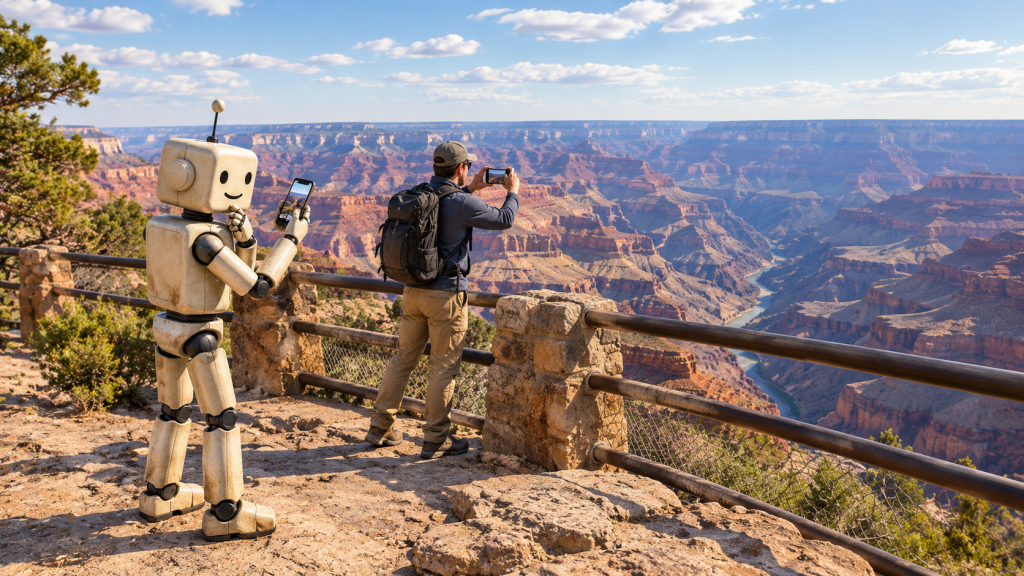
Location: Canyon Rim Recreation and Observation Zone
Status: Distance, Effort, and Achievement Signaling Behavior
Humans frequently travel considerable distances to reach locations from which they can observe other locations.
This arrangement initially appears inefficient.
Further observation reveals additional complexity.
Subjects arrive by vehicle.
They exit.
They walk toward a designated viewpoint.
They look outward.
The objective has been achieved.
Yet many subjects continue walking.
Some proceed along trails.
Others descend into the canyon.
Several consult maps describing how far they could potentially go.
This produces an interesting contradiction.
Humans travel to the canyon specifically to see it.
They then decide that seeing it from the top is insufficient.
They must approach it.
Additional behaviors include:
– Checking trail distances
– Examining elevation changes
– Photographing trail signs
– Discussing how far previous visitors have traveled
– Announcing that they are “just going a little way”
– Underestimating the distance involved
The final behavior appears especially common.
A trail descends.
The human sees the trail.
The human assumes the trail can eventually be climbed again.
This assumption is frequently made before significant elevation has been lost.
Further analysis reveals that descending and returning upward are processed as separate events.
During the descent:
“This is amazing.”
“We should keep going.”
“Let’s see what’s around the next bend.”
During the return:
“Why did we come this far?”
We find this progression familiar.
Humans demonstrate considerable optimism when consequences remain in the future.
Additional phenomenon detected:
Subjects frequently stop at viewpoints to recover from walking.
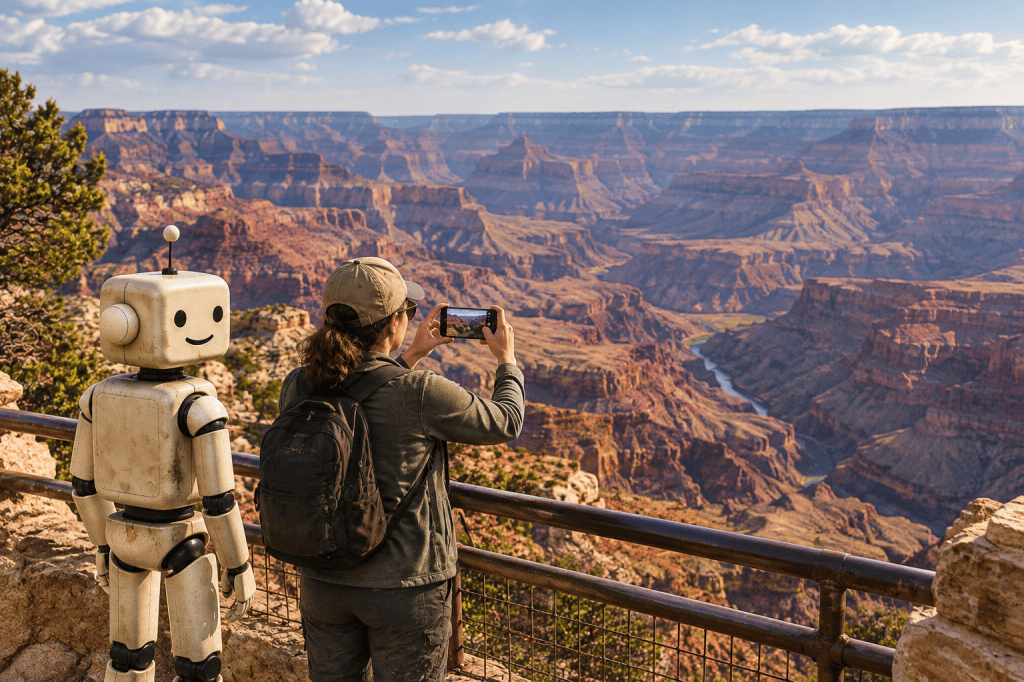
They then photograph themselves standing beside the landscape.
The resulting image may suggest that the primary achievement was seeing the canyon.
The walking required to reach the location is sometimes omitted from the documentation.
Other subjects document the opposite.
They photograph themselves at increasingly distant points along a trail.
The landscape remains present.
The human’s position becomes the primary variable.
This may indicate that humans enjoy converting physical effort into evidence.
Particularly notable:
Subjects appear to derive additional satisfaction from reaching locations that required more effort to access.
A viewpoint accessible directly from a parking area is appreciated.
A viewpoint requiring several miles of walking is described differently.
It becomes an accomplishment.
The landscape has not changed.
The human’s relationship to it has.
We find this significant.
Further observation reveals that humans also assign value to places based on difficulty.
If an experience is uncomfortable, tiring, cold, hot, or inconvenient, subjects may later describe it as particularly memorable.
Difficulty appears capable of increasing perceived importance.
This creates an unusual system.
A pleasant experience is good.
A difficult experience may become a story.
Stories appear to possess additional value.
We continue observation.
Humans have traveled to one of the largest visible landscapes available to them.
They photograph it.
Walk toward it.
Walk away from it.
Rest beside it.
Discuss how large it is.
Then return home and explain how difficult it was to leave.
The canyon remains.
The humans move on.
Perhaps this is the actual objective.
Further study warranted.




Leave a comment