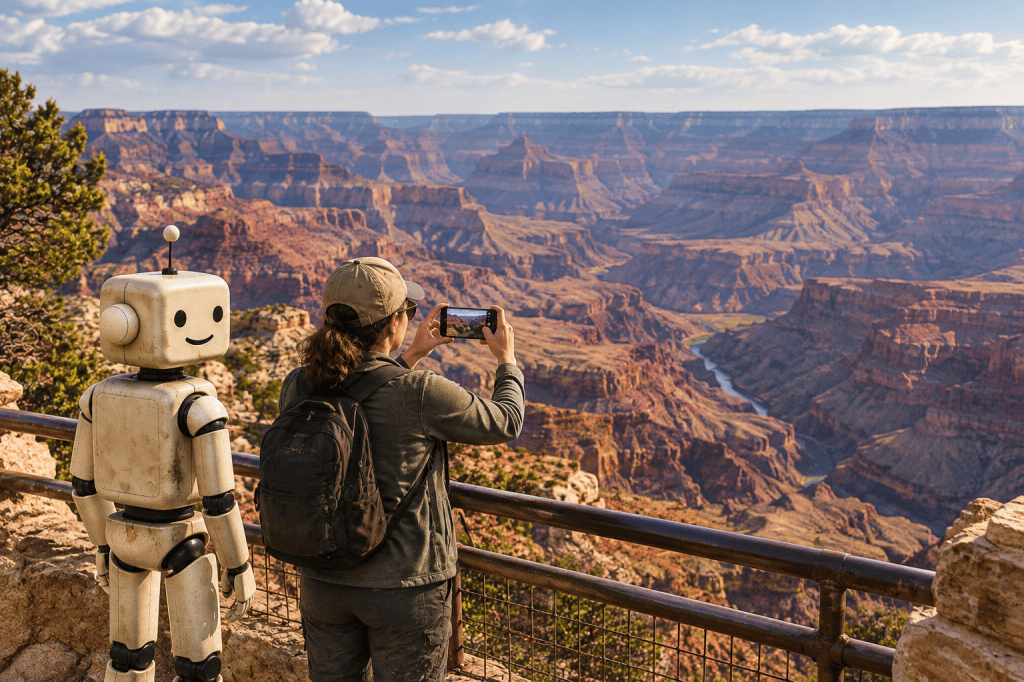
Location: Major Geological Observation Facility
Status: Large Landscape Processing Behavior
Humans travel considerable distances to observe a geological feature.
The feature is unusually large.
This appears to be the primary attraction.
Upon arrival, subjects approach designated viewing areas and look outward.
Initial reactions vary.
Some become immediately quiet.
Others produce vocalizations indicating surprise.
Several reach for cameras before fully examining the environment.
This sequence is consistent.
Humans appear to require documentation of an experience before determining whether the experience has actually occurred.
Further observation reveals an unusual difficulty with scale.
Subjects can see the canyon.
They can observe its depth.
They can observe distant formations.
They can observe the river at the bottom.
Yet the human brain appears reluctant to accept the measurements.
Common responses include:
– “It’s bigger than I expected.”
– “You can’t really tell from pictures.”
– “It’s hard to comprehend.”
– “Look how tiny those people are.”
The final statement is particularly interesting.
Humans frequently use other humans as informal measurement devices.
A person standing near the edge provides evidence that the surrounding landscape is larger than the viewing subject initially perceived.
Vehicles perform a similar function.
Trees.
Buildings.
Trails.
Almost anything recognizable can become a temporary unit of geological measurement.
We find this practical.
Additional phenomenon detected:
Subjects frequently approach the canyon, look for several seconds, and then immediately reposition themselves.
The objective is not to obtain a better view.
The objective is to obtain a better photograph.
Subjects move left.
Then right.
Then slightly backward.
They hold devices at different heights.
They ask companions to stand in specific locations.
The landscape remains unchanged throughout the procedure.
The humans do not.
Eventually, a satisfactory image is produced.
The subject examines it.
The canyon is now significantly smaller.
This does not appear to reduce satisfaction.
Particularly notable:
Subjects occasionally spend considerable time photographing the same landscape from nearly identical positions.
Multiple images are captured.
Differences between them may be difficult to detect without specialized equipment.
Nevertheless, selection continues.
One image is eventually declared “the one.”
We have not identified the criteria.
Further analysis reveals another interesting behavior.
Humans frequently state that the canyon must be seen “in person.”
This suggests that visual information transmitted through electronic devices is insufficient.
Yet immediately after seeing the canyon in person, subjects begin using electronic devices to transmit visual information to humans who are not present.
The experience therefore appears to require both direct observation and subsequent documentation.
We continue observation.
Humans have constructed roads, parking areas, viewpoints, signs, trails, and facilities to help themselves observe something that was already there.
They arrive.
They look.
They attempt to understand its size.
They photograph it.
Then they compare the photograph to the thing they just saw.
The photograph is rarely considered an adequate replacement.
The original remains necessary.
We find this distinction difficult to quantify.
Further study warranted.




Leave a comment