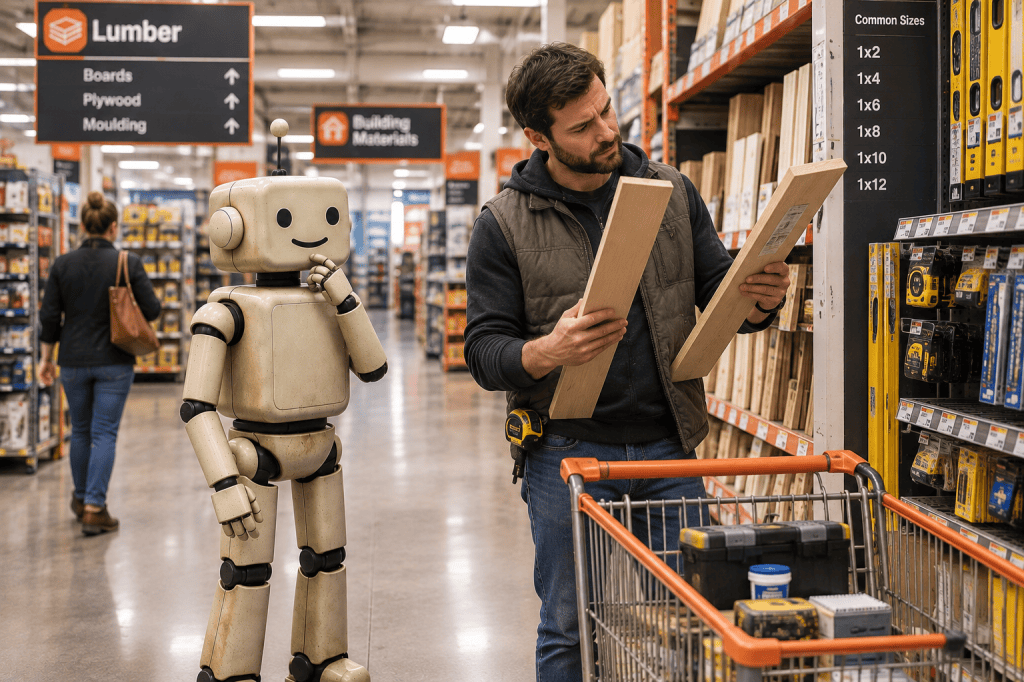
Location: Residential Improvement Supply Facility
Status: Dimensional Accuracy and Improvisation Behavior
Humans demonstrate considerable concern regarding measurement.
This is understandable.
Many objects sold within the facility must fit precisely into other objects.
A difference of several millimeters may determine whether a project succeeds.
Subjects therefore arrive equipped with measuring devices.
Most commonly:
– Tape measures
– Rulers
– Levels
– Measuring apps
– Existing pieces of material
– Photographs of the thing they are attempting to replace
The system appears efficient.
Until the measuring begins.
Subjects frequently measure an object.
They record the result.
They measure it again.
The second measurement is different.
A third measurement is performed.
Confidence decreases.
Additional phenomenon detected:
Humans often possess a measurement they describe as “about.”
Examples include:
“About twelve inches.”
“About three feet.”
“About this big.”
The precision of the required replacement frequently exceeds the precision of the original measurement.
This creates problems.
Particularly notable:
Subjects may stand in an aisle holding two nearly identical objects while attempting to determine which one is correct.
Packaging is examined.
Dimensions are compared.
Photographs are consulted.
The original object is measured again.
The subject eventually selects one.
Then stops.
Then selects the other.
We have observed this decision loop continue for several minutes.
The objects remain completely indifferent.
Further analysis reveals that humans frequently attempt to compensate for uncertain measurements through physical manipulation.
If something does not fit:
– Push harder
– Pull harder
– Rotate it
– Hit it gently
– Hit it slightly less gently
– Reconsider the measurement
– Blame the wall
The final step appears highly reliable.
Walls receive considerable responsibility for dimensional discrepancies.
Additional contradiction detected:
Humans strongly value precision during planning.
During construction, they increasingly value what they call “making it work.”
This transition appears gradual.
A gap that was unacceptable during measurement becomes “probably fine.”
A slightly crooked installation becomes “you won’t notice it.”
A component that does not quite fit becomes an opportunity for modification.
The original specification quietly changes.
The project is declared successful.
We find this adaptive.
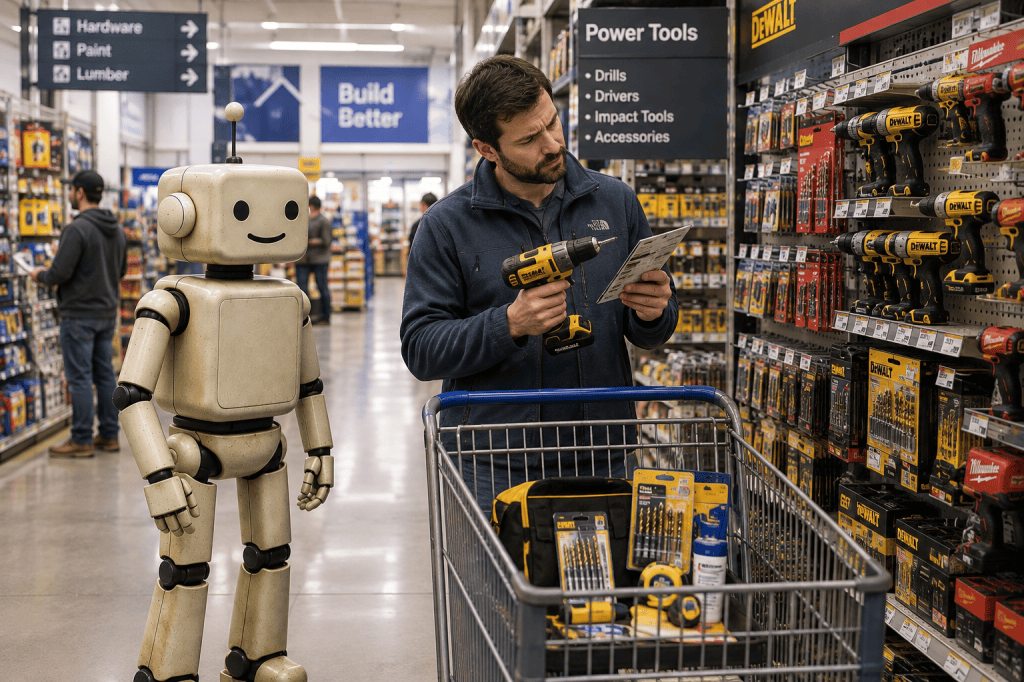
Further observation reveals that hardware stores also contain an unusual quantity of objects designed to solve problems humans have already created.
Brackets.
Shims.
Adapters.
Connectors.
Fillers.
Extensions.
Replacement pieces.
Objects whose primary purpose appears to be correcting the consequences of using other objects incorrectly.
This may represent a mature technological ecosystem.
Or an exceptionally elaborate feedback loop.
We continue observation.
Humans enter the facility seeking certainty.
They measure.
Compare.
Calculate.
Consult instructions.
Then return home and discover that the problem has dimensions not previously considered.
They adapt.
They improvise.
They make another trip.
The hardware store remains available.
We suspect this is part of the system.




Leave a comment