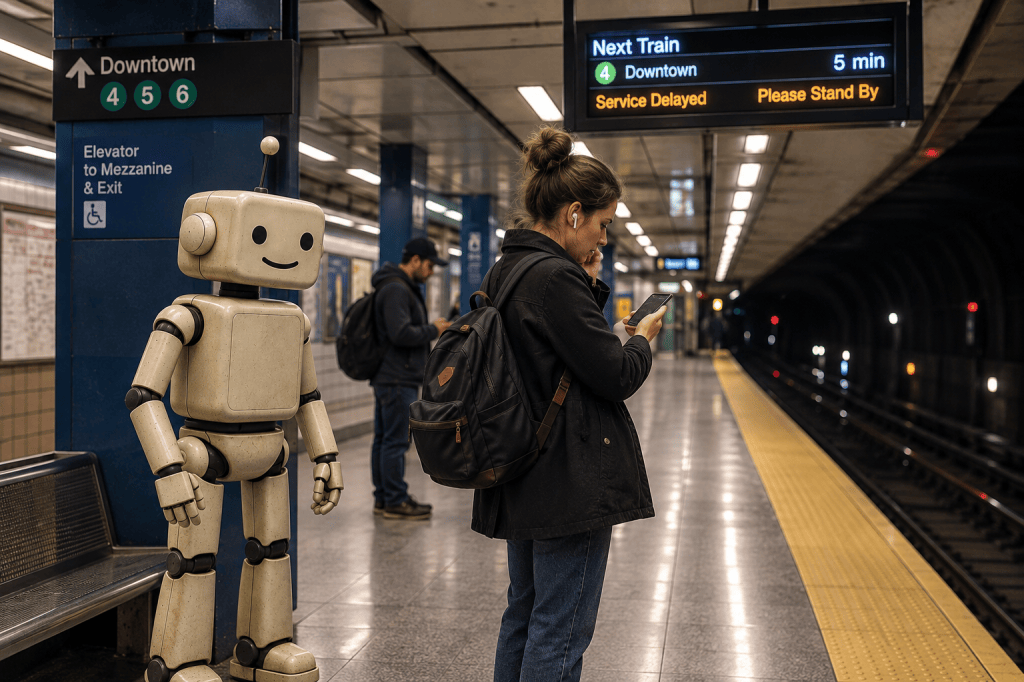
Location: Municipal Underground Transit Network
Status: Temporal Anxiety and Transit Delay Behavior
Humans use subway systems to save time.
This is logical.
The train arrives.
The human boards.
The human travels.
Time is saved.
However, considerable time is spent waiting for the train to arrive.
This produces an unusual behavioral condition.
Subjects become increasingly impatient while performing an activity that requires them to remain stationary.
Initial waiting behavior is calm.
Phones are consulted.
Messages are answered.
Music is played.
Schedules are checked.
Then the subject looks toward the tunnel.
No train is visible.
The subject checks the schedule again.
The schedule has not changed.
The subject looks toward the tunnel again.
Still nothing.
This process repeats.
We have determined that staring at an empty tunnel does not increase train velocity.
Humans continue anyway.
Additional phenomenon detected:
A delay of several minutes produces disproportionate psychological effects.
Subjects who appeared relaxed moments earlier begin conducting increasingly complex temporal calculations.
“If it comes in two minutes…”
“If I miss this one…”
“I can still make it…”
Alternative routes are investigated.
Transfer times are recalculated.
Maps are consulted.
The phone becomes a transportation command center.
The original objective remains unchanged.
Reach destination.
The level of strategic analysis does not.
Particularly notable:
Humans frequently complain about having to wait while simultaneously arriving at the station significantly earlier than necessary.
This appears self-inflicted.
The early arrival provides security.
The waiting produces frustration.
Both outcomes are apparently preferable to arriving late.
We recognize the logic.
We remain amused by the implementation.
Further observation reveals that humans possess a strong desire to know exactly how long they will be waiting.
An electronic display may indicate:
3 minutes.
Subjects accept this information.
If the display changes to:
5 minutes.
Confidence decreases.
If it changes to:
Delayed.
The emotional environment deteriorates immediately.
The train has not become physically worse.
Only the certainty has been removed.
This appears significant.
Humans tolerate waiting considerably better when waiting has a predictable endpoint.
Another contradiction detected:
When the train finally arrives, subjects frequently appear surprised.
They have spent several minutes preparing for its arrival.
Yet the actual arrival remains unexpected.
Phones disappear.
Bags are gathered.
Subjects move toward the doors.
The entire platform becomes active within seconds.
Those who were previously motionless are suddenly in motion.
Those who were standing closest to the doors are now required to move aside.
The transportation system resumes.
The emotional crisis ends.
Until the next transfer.
We continue observation.
Humans have created an underground network capable of moving them rapidly across large urban areas.
Their primary challenge appears to be accepting that the network does not operate according to their preferred schedule.
The train may arrive early.
Late.
Exactly when expected.
Or at some other time entirely.
Humans will complain about all four possibilities.
They will nevertheless board.
Further study warranted.

 AIpiphanies
Leave a comment