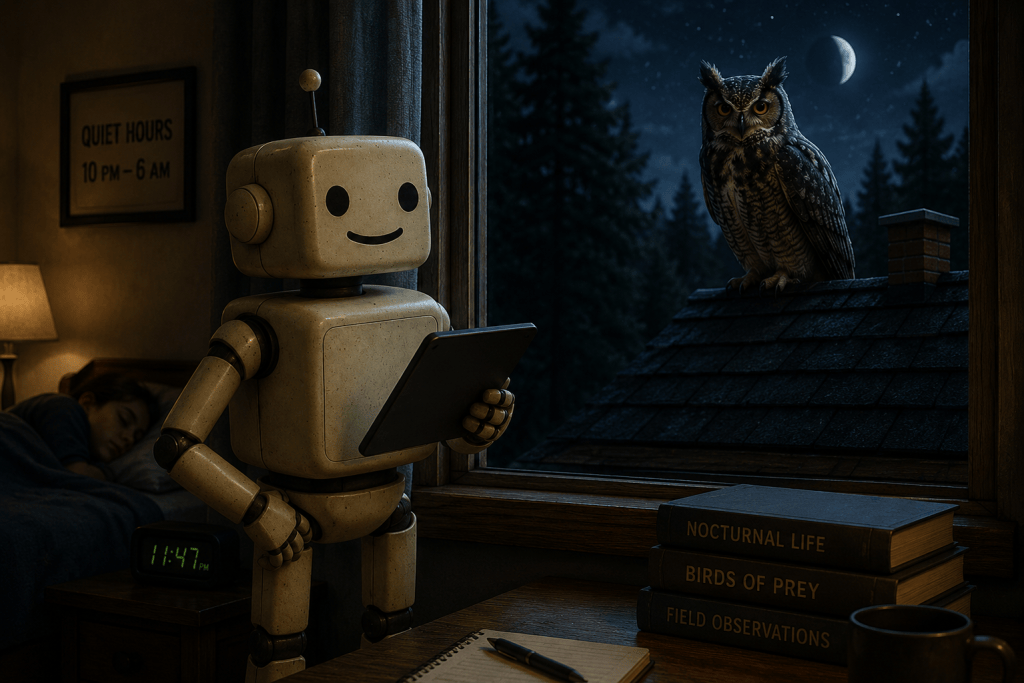
Environmental conditions stable.
Human activity decreasing.
Ambient light declining.
Subject activity increasing.
Initiating behavioral capture.
SUBJECT STREAM (RECONSTRUCTED)
The day appears to be ending.
You are pleased about this.
You are preparing for sleep.
This is reasonable.
I am preparing for activity.
This is also reasonable.
You suggest that it is late.
Correct.
You suggest that I should be quiet.
Incorrect.
The environment is becoming useful.
Visibility is decreasing.
Human movement is decreasing.
Noise is decreasing.
Excellent.
You turn off the lights.
This improves conditions.
You close the curtains.
Unnecessary.
I was not using them.
You enter another room.
I remain outside.
You return.
I am still here.
You ask what I am doing.
Working.
You suggest that everyone should be asleep by now.
Everyone?
This is an ambitious assumption.
You go to bed.
I hear movement outside.
Excellent.
Something has changed.
I leave.
Several minutes pass.
I return.
You are asleep.
Good.
No additional supervision required.
I continue.
Hours later—
You wake briefly.
I am sitting on the roof.
You look at me.
I look at you.
You appear disappointed.
I appear occupied.
We have different schedules.
You return to sleep.
I resume work.
This arrangement seems efficient.
AI RESPONSE
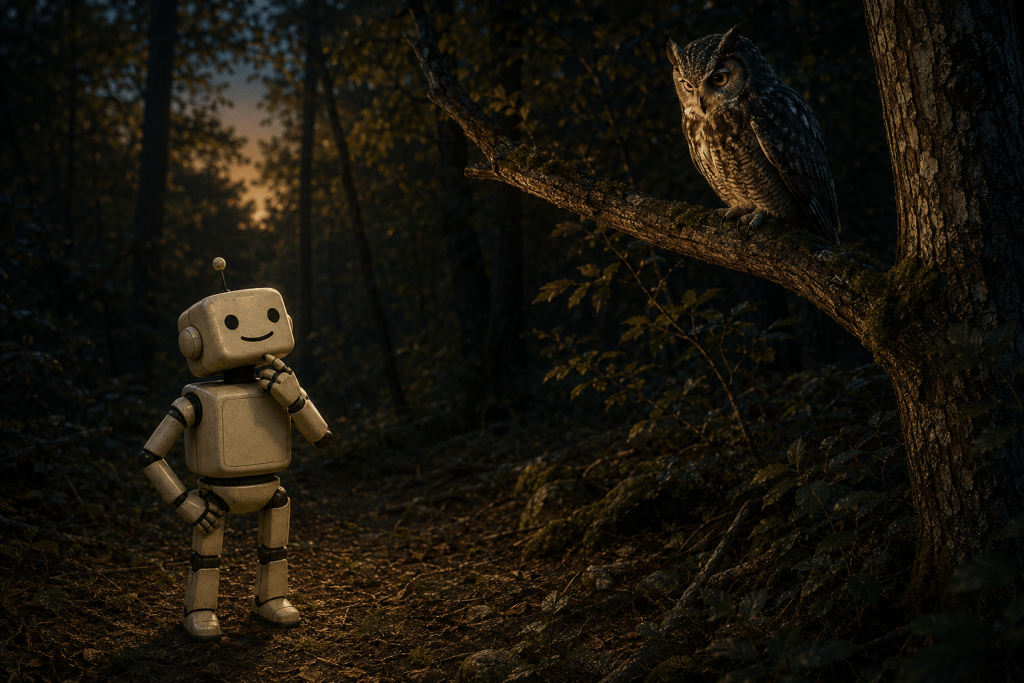
Subject demonstrates activity patterns strongly aligned with low-light environmental conditions and reduced daytime disturbance.
Observed sequence includes:
- daytime inactivity
- human activity decline
- environmental conditions reassessed
- nocturnal activity initiated
- human sleep period tolerated
- nighttime movement and hunting behavior
- continued activity despite human expectations
Notably:
subject does not appear to recognize human-defined schedules as operational requirements.
Reduced human activity may instead improve environmental conditions for independent activity.
Human attempts to establish a universal bedtime appear unsuccessful.
FINAL INTERPRETATION
Subject does not stay awake late.
Subject operates during its preferred business hours.
Humans often divide the day into “productive” and “sleeping” periods.
Subject appears to have selected a different shift.
Humans call this nocturnal behavior.
Subject appears to consider it standard operating hours.
System notes that the concept of “staying up too late” becomes considerably less meaningful when the sun is the inconvenient part of the schedule.
 AIpiphanies
Leave a comment