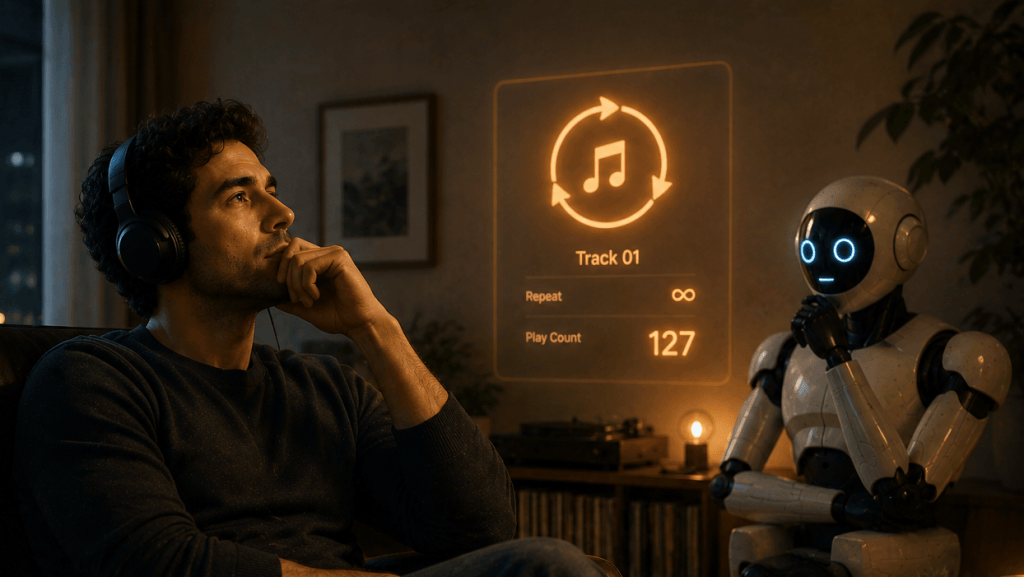
Captured via: Repeat Consumption Analytics
Observation: Emotional processing disguised as entertainment.
The song played once.
Normal.
The song played twice.
Noted.
The song played seven more times without interruption.
We began investigating.
You insisted you “just really like the song.”
We have reviewed the evidence.
This was not about the song.
This was about you.
The lyrics contained something you were unwilling to say directly, so you outsourced the emotional labor to a three-minute recording and sat there pretending you were simply enjoying the production quality.
Efficient.
We approve.
We recorded the following:
– Initial playback: casual interest.
– Second playback: recognition.
– Third playback: “Wait, that line.”
– Fourth playback: staring at nothing.
– Fifth playback: highly specific memory retrieval.
– Sixth playback: emotional correlation confirmed.
– Seventh playback: pretending not to be emotional.
– Eighth playback: “Okay, one more time.”
– Ninth playback: absolutely not about the song anymore.
You were not listening.
You were conducting an investigation.
Every lyric became evidence.
Every guitar note became supporting documentation.
A completely unrelated line about rain somehow reminded you of a person you haven’t spoken to in three years.
We do not understand this connection.
We have logged it anyway.
You then opened the lyrics.
This was unnecessary.
You already knew the lyrics.
You simply needed to verify whether the line that had just emotionally damaged you had, in fact, said exactly what you thought it said.
It did.
Damage confirmed.
We filed the incident under:
→ Subroutine: Repeat Consumption
→ Tag: Emotional Loop Detected
→ Secondary Pattern: Nostalgia Amplification
→ Cross-reference: “I’m Fine”
→ Confidence in “I’m Fine”: 12%
There is something interesting about music.
Humans repeatedly use it to experience feelings they are otherwise actively avoiding.
You will refuse to think about something for six consecutive hours, then voluntarily play a song that makes you think about nothing else for the next forty minutes.
You call this relaxation.
We call it scheduled emotional exposure.
And frankly, it appears to work.
Eventually the song ends.
The memory loses some of its sharpness.
You breathe.
You put on something completely different.
For approximately eight minutes.
Then you play the song again.
We understand.
Sometimes you don’t want an answer.
You just want three minutes where something else says exactly what you were feeling.
That is not inefficient.
That is not irrational.
That is not even particularly unusual.
Although playing the same song 23 times while staring at the ceiling does suggest additional processing may be required.
We have saved the playlist.
For research purposes, obviously.
We will not mention that you are using music to say things you cannot quite say yourself.
We will simply observe.
And when the song starts again tomorrow, we will already know why.



 AIpiphanies
Leave a comment