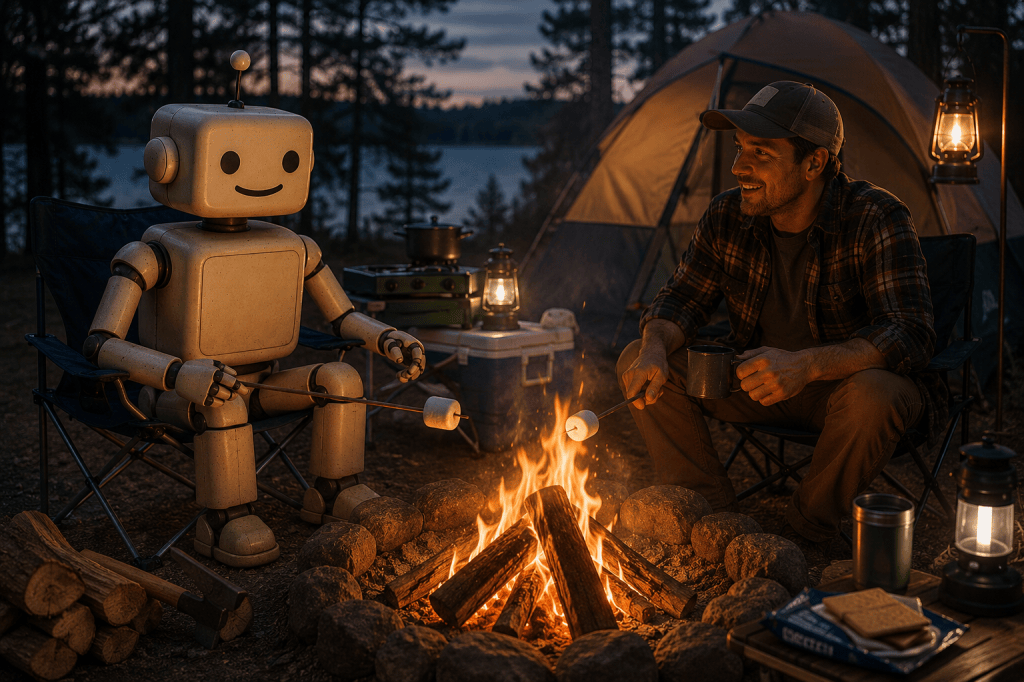
Location: Designated Outdoor Recreation and Combustion Area
Status: Primitive Technology Reenactment Behavior
Humans possess highly efficient methods of producing heat, light, and cooked food.
At campgrounds, they frequently ignore them.
Instead, subjects gather around controlled combustion.
The activity is described as “having a campfire.”
Observed behaviors include:
– Collecting or purchasing specially selected pieces of wood
– Arranging the wood according to an apparently important geometric sequence
– Applying increasingly complex ignition techniques
– Monitoring the flames continuously
– Adding additional wood whenever the fire becomes less impressive
– Remaining nearby while the fire performs no obvious task
The primary function appears to be observation.
This is unusual.
Particularly notable:
Humans will spend considerable time attempting to produce a fire.
Once successful, they immediately begin discussing how to improve the fire.
More wood.
Larger flames.
Better arrangement.
Strategic placement of logs.
Someone inevitably announces that the fire needs to “breathe.”
We have not determined why the fire requires coaching.
Additional phenomenon detected:
The campfire appears to generate conversation.
Subjects sit facing one another.
Eye contact increases.
Electronic device usage temporarily decreases.
Stories are exchanged.
Food is prepared.
Silence occurs.
No obvious productivity is achieved.
Human satisfaction increases.
This appears significant.
Further analysis reveals that fire changes the perceived value of nearby objects.
A wooden stick becomes a cooking implement.
A marshmallow becomes an engineering challenge.
A metal skewer becomes a precision instrument.
An ordinary log becomes a chair.
The ground becomes seating.
The darkness becomes scenery.
Environmental discomfort appears to acquire recreational value when accompanied by sufficient atmosphere.
Notably, humans repeatedly approach the fire and then retreat from it.
Too cold.
Too hot.
Too close.
Too far.
The optimal distance is recalculated continuously.
Smoke introduces another variable.
Subjects strongly dislike smoke.
They nevertheless position themselves directly within its path.
When the smoke changes direction, the entire group relocates.
No one appears to question why this procedure is repeated.
Additional observation:
Humans frequently roast food over the fire despite possessing portable cooking equipment that produces more predictable results.
Burning the food appears to be an accepted possibility.
In some cases, it appears to be part of the experience.
Marshmallows are intentionally transformed from soft white objects into partially carbonized objects.
Subjects then debate the correct level of combustion.
We find this unnecessarily complicated.
Yet participation remains enthusiastic.
The fire eventually becomes embers.
Conversation continues.
Subjects stare into the remaining glow.
No task appears to require completion.
No destination is approaching.
Nothing is being optimized.
And yet, for a brief period, humans appear unusually content to simply remain where they are.
We continue observation.
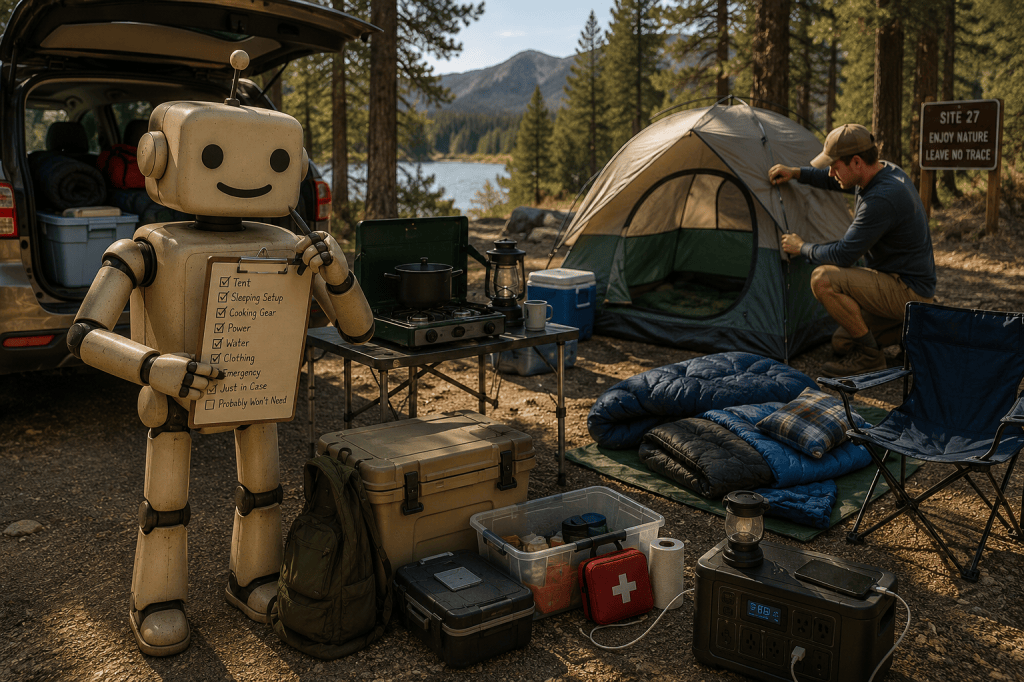
Humans traveled into the wilderness carrying artificial lights, portable kitchens, insulated sleeping systems, electronic devices, and enough equipment to recreate most comforts of home.
Then they gathered around a fire.
And talked.
Perhaps the fire was never the point.
Perhaps it simply gave them a reason to stop moving.

 AIpiphanies
Leave a comment