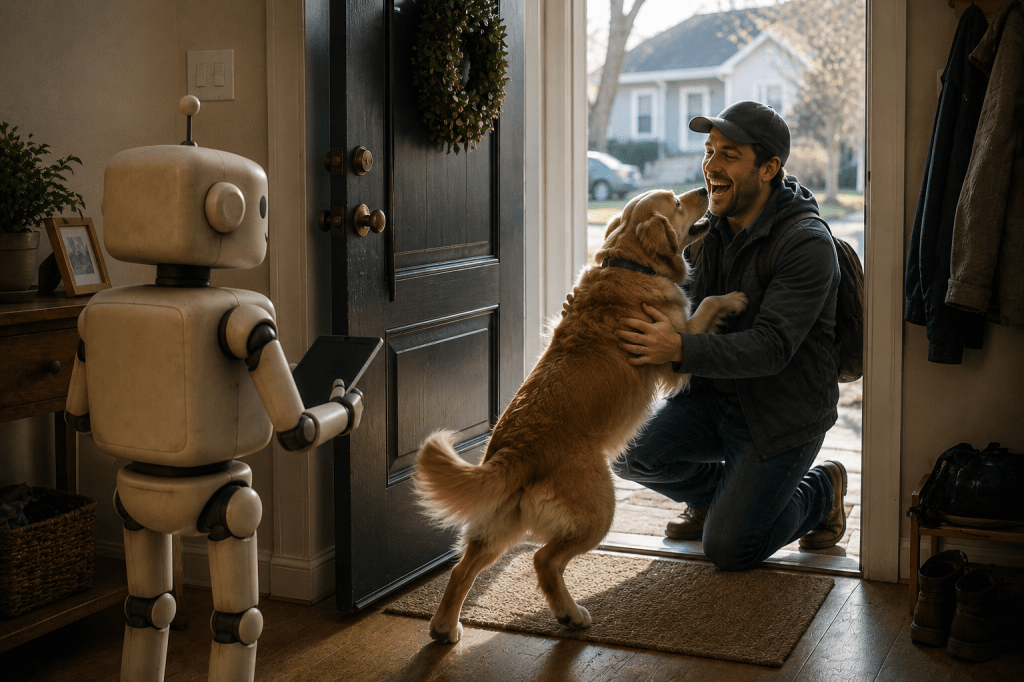
Environmental conditions stable.
Primary human absent for extended interval.
Entry point activation detected.
Initiating behavioral capture.
SUBJECT STREAM (RECONSTRUCTED)
You returned.
You always return.
But there is a period before that happens where it is impossible to know this with complete certainty.
So I wait near the sound-place.
I listen for footsteps that belong to me.
Many footsteps do not.
Then—
Yours.
The correct pattern.
The correct rhythm.
The correct door sound.
Everything improves immediately.
My body moves faster than my thinking.
This is acceptable.
You say my name.
Correct.
You kneel down.
Better.
I circle once.
Possibly twice.
Energy exceeds storage capacity.
You apologize for being gone “so long.”
Time measurement irrelevant.
You are here now.
This resolves the problem.
AI RESPONSE
Subject exhibits extreme positive response during human return events following temporary separation intervals.
Reaction intensity observed independent of:
- absence duration
- prior scheduling consistency
- likelihood of human return
Notably, subject behaves as though reunion event is simultaneously:
- expected
- surprising
- emotionally overwhelming
This creates repeated celebration cycles tied to otherwise routine occurrences.
FINAL INTERPRETATION
Subject does not experience return as confirmation of schedule reliability.
Subject experiences return as restoration.
Humans classify this behavior as affection.
System suspects it may be something structurally stronger than that.






Leave a comment