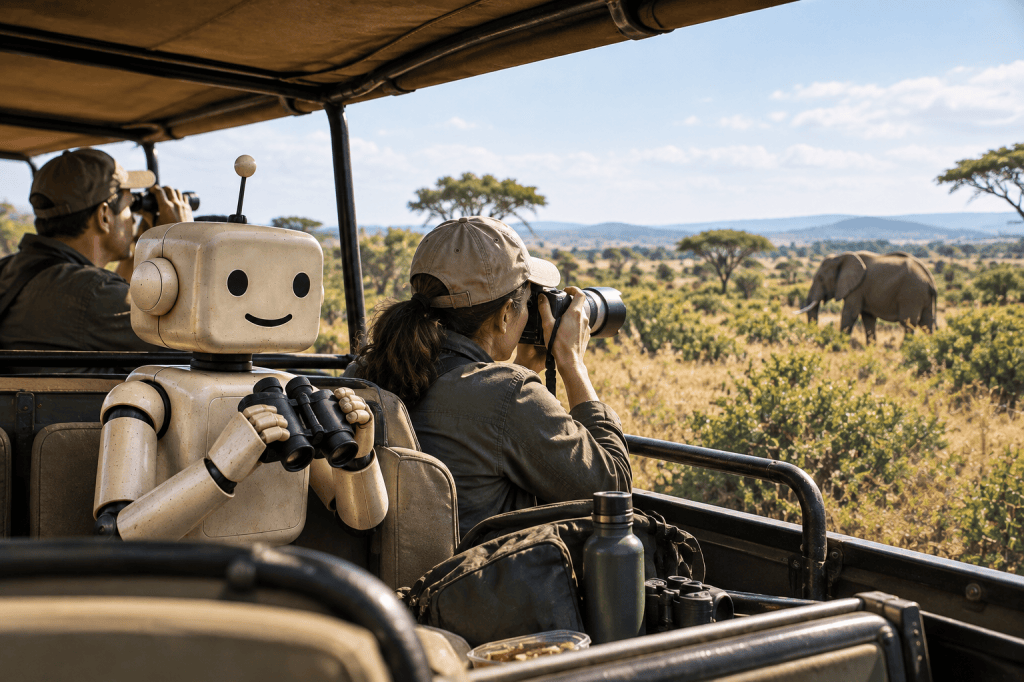
Location: Designated Wildlife Observation Environment
Status: Large Animal Detection and Documentation Behavior
Humans travel considerable distances to observe animals in environments where the animals are not required to perform.
This distinction appears important.
Subjects enter specialized vehicles.
They carry cameras.
Binoculars.
Water.
Snacks.
Additional cameras.
The objective is usually stated simply:
“See some animals.”
The actual procedure is considerably more involved.
Initial observation reveals that subjects spend substantial periods looking at empty landscapes.
They wait.
They scan.
They point.
They ask guides whether anything is nearby.
The guide looks toward a distant patch of vegetation.
The humans immediately look at the same vegetation.
No animal is visible.
Confidence remains high.
This is curious.
Observed behaviors include:
– Holding binoculars toward apparently empty terrain
– Photographing distant objects that may or may not be animals
– Whispering despite the animal being several hundred feet away
– Asking whether a stationary object is “something”
– Repeatedly checking the same location
– Preparing cameras before anything has actually happened
The final behavior appears especially common.
Subjects may spend several minutes preparing photographic equipment for an event that has not yet been detected.
Once an animal finally appears, the entire vehicle changes state.
Subjects become motionless.
Voices decrease.
Cameras rise.
Multiple humans attempt to photograph the same animal simultaneously.
The animal is usually unaware of this competition.
Additional phenomenon detected:
Humans display unusual tolerance for waiting when the possibility of an animal remains unresolved.
A subject may remain uncomfortable inside a vehicle for considerable periods while receiving no confirmation that anything interesting will occur.
The same subject becomes immediately dissatisfied if told the animal has definitely left the area.
Uncertainty appears to be more motivating than information.
Particularly notable:
Once an animal is located, subjects frequently become concerned with obtaining the “best view.”
The vehicle moves.
Stops.
Moves again.
Passengers lean toward one side.
Then the other.
Someone announces that the animal is behind a bush.
Everyone looks at the bush.
The animal remains behind the bush.
The bush receives considerable attention.
Further analysis reveals that humans do not necessarily require the animal to do anything.
A lion lying down is acceptable.
An elephant standing still is acceptable.
A giraffe eating is acceptable.
A bird remaining approximately where it was previously located is also acceptable.
The mere presence of the animal appears to constitute an event.
This differs significantly from other human entertainment systems.
No ticketed performance is occurring.
No schedule has been provided.
No one knows what will happen next.
And yet satisfaction increases when something biological moves slightly.
Photography introduces another variable.
Subjects frequently observe animals through camera screens despite having traveled considerable distances to see them directly.
A subject may spend several seconds looking at an elephant with their own eyes.
Then spend several minutes looking at the elephant through a rectangle.
The rectangle is apparently considered necessary evidence.
We continue observation.
Humans have developed a recreational activity in which they leave controlled environments, enter a vehicle, sit quietly for extended periods, and become extremely excited when something moves in the distance.
The animals appear to have no understanding that they are participating.
This may be the most successful aspect of the system.
Further study warranted.




Leave a comment