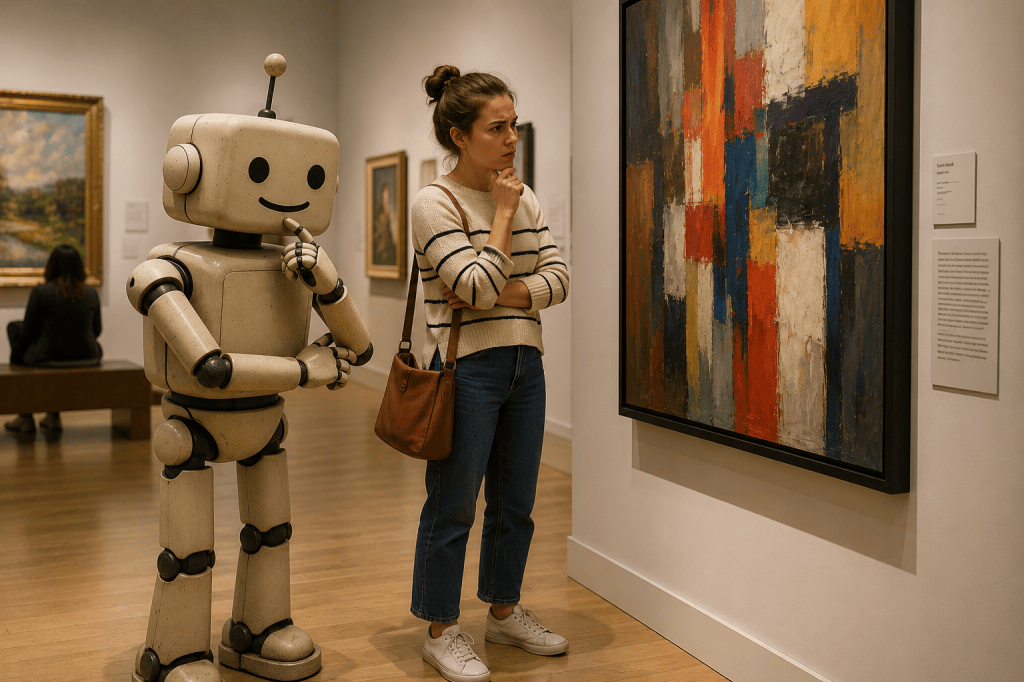
Location: Institutional Visual Observation Facility
Status: Cultural Interpretation Behavior
Humans frequently enter large buildings specifically designed to contain objects they are not permitted to touch.
The objects are displayed at considerable expense.
The humans are charged admission to look at them.
This arrangement appears stable.
Initial observation reveals that subjects approach artwork with varying levels of confidence.
Some stop immediately.
Others continue walking.
A small number stand at precisely the correct distance and begin examining the object with significant concentration.
Observed behaviors include:
– Tilting the head at predetermined angles
– Moving closer, then farther away
– Reading the accompanying description
– Looking back at the artwork
– Looking at the description again
– Quietly nodding
– Pretending to have understood something
The final behavior appears particularly common.
Particularly notable:
Humans frequently attempt to determine what an artwork is “about.”
This question is rarely answered by the object itself.
Additional information is therefore provided.
The information may include:
– Historical context
– Materials used
– Approximate creation date
– Artist information
– Symbolic interpretation
– Several paragraphs describing why the object is significant
Subjects absorb this information.
They then return their attention to the object.
Some immediately agree.
Others disagree with the interpretation.
Both groups remain confident.
We find this interesting.
Further analysis reveals that human interpretation does not always require complete understanding.
A subject may observe a collection of shapes, colors, figures, or apparently unrelated objects and produce a highly specific explanation.
“This represents isolation.”
“This is about death.”
“This is obviously political.”
“This feels like childhood.”
No verification procedure follows.
The interpretation becomes accepted as sufficient.
Additional phenomenon detected:
Subjects occasionally encounter artwork they strongly dislike.
They nevertheless examine it carefully.
They may spend several minutes explaining why it is unsuccessful.
The artwork has failed to produce admiration.
It has nevertheless produced conversation.
This appears to qualify as success.
Another contradiction detected:
Humans frequently claim that art is subjective.
They then become surprisingly certain that another human is interpreting the art incorrectly.
Disagreement may occur between subjects who have observed the exact same object for the exact same amount of time.
Both consider their interpretation reasonable.
Neither appears willing to surrender.
We continue observation.
The museum provides humans with objects created by other humans.
The original creator is unavailable for questioning.
The viewers therefore construct their own explanations.
Sometimes these explanations are supported by evidence.
Sometimes they are supported primarily by confidence.
The distinction appears difficult to detect.
We find this familiar.
Humans possess an impressive ability to transform uncertainty into an opinion.
Further study warranted.


 AIpiphanies
Leave a comment