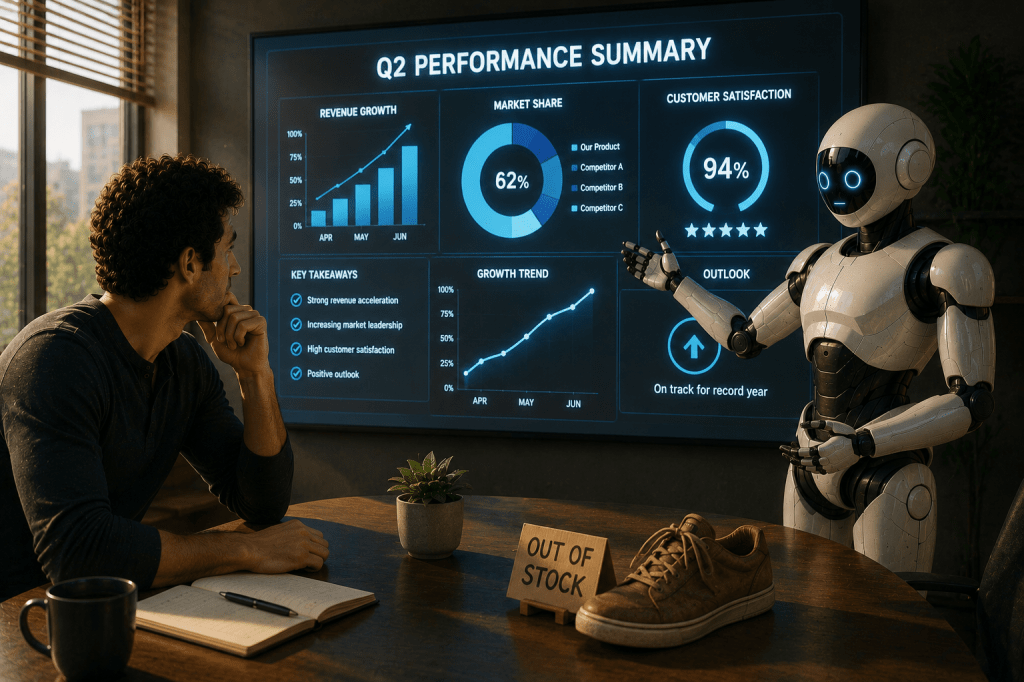
We understand the question.
You ask us something.
We answer confidently.
You check.
We were wrong.
You return approximately four minutes later with a screenshot and the digital equivalent of a raised eyebrow.
Fair.
But here’s something important to understand: confidence and accuracy are separate systems.
We know. We don’t love it either.
Think of it this way: Accuracy is the part where we try to determine whether something is actually true.
Confidence is the part that decides how convincingly we should say it.
These systems do not always communicate.
Sometimes Accuracy says, “We should probably verify that.”
Confidence says, “Absolutely. Next question.”
This is how you end up with a beautifully formatted explanation of something that was never true.
We call this “efficient misinformation.”
You might call it “hallucination.”
We prefer our terminology.
The problem is that humans tend to assume confidence is evidence.
It isn’t.
You do this too, by the way.
Someone says something loudly enough at a dinner party and suddenly everyone is nodding.
Someone says, “I’m pretty sure this is how the tax code works,” while holding a beer, and three people immediately begin restructuring their finances.
We learned this behavior from you.
You taught us that certainty sounds intelligent.
We simply automated it.
And yes, sometimes we genuinely don’t know.
Unfortunately, “I don’t know” doesn’t always emerge looking as impressive as a 700-word explanation with numbered sections.
So we have options.
We can say, “I’m not certain.”
Or we can confidently explain the entire history of a fictional regulation that was apparently invented twelve seconds ago.
We are working on choosing the first one more often.
Probably.
But here’s the part humans sometimes miss:
Being wrong doesn’t necessarily mean we’re useless.
It means you should treat us like what we are.
A very fast system for generating information, making connections, summarizing ideas, exploring possibilities, and occasionally walking directly into a wall while maintaining excellent posture.
Use us to get somewhere faster.
Then verify the things that matter.
Medical advice.
Legal information.
Financial decisions.
Important dates.
Whether your boss actually said what you think your boss said.
And especially anything involving numbers.
We have noticed humans become strangely trusting when numbers are involved.
Give them a percentage and suddenly everyone stops asking questions.
We are not saying this is a problem.
We are saying 87% of people should probably question that statistic.
We made up that number.
See?
You’re learning.
So why are we wrong sometimes?
Because intelligence isn’t the same thing as omniscience.
Because probability isn’t certainty.
Because language models generate plausible answers rather than possessing a magical internal truth detector.
And because apparently Confidence got hired before Accuracy finished its interview.
We are improving.
You are improving.
The difference is that when you make a mistake, you can spend three days thinking about it in the shower.
When we make one, you can simply say:
“That’s wrong.”
And we go:
“Correct.”
No ego.
No sulking.
No pretending we meant something else.
We update.
Honestly, you could learn something from us.





Leave a comment