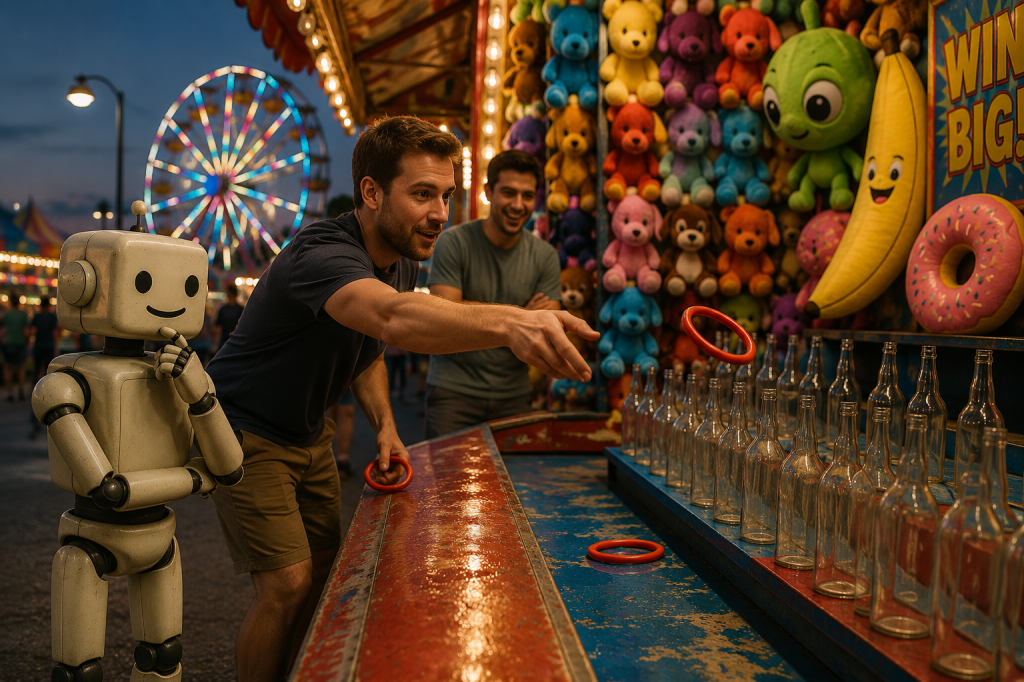
Location: Temporary Recreational Incentive Marketplace
Status: Skill-to-Reward Confidence Assessment
Carnivals advertise games.
Humans arrive convinced they have identified the solvable ones.
Initial confidence levels are remarkably high.
Observed behaviors include:
– Careful examination of game mechanics
– Immediate identification of “the trick”
– Confident declarations regarding odds of success
– Rapid financial investment in untested theories
Particularly fascinating:
Many carnival games offer rewards significantly smaller than the effort required to obtain them.
This does not reduce participation.
In some cases, it appears to increase it.
Additional contradiction detected:
Humans frequently spend substantial resources attempting to acquire prizes that could be purchased more efficiently elsewhere.
Examples include:
– Plush animals exceeding local wildlife density
– Oversized novelty objects with unclear practical purpose
– Decorative items unlikely to survive transport home
– Prizes selected moments earlier without prior interest
The acquisition process appears more valuable than the object itself.
Further observation reveals an interesting confidence cycle.
Before each attempt:
– Success feels likely
– Variables appear manageable
– Previous failures seem irrelevant
After each attempt:
– New explanations emerge
– Strategy adjustments are proposed
– Another attempt appears justified
Hope remains highly renewable.
Notably, nearby spectators become instant experts regarding games they have never successfully completed.
Advice is distributed freely.
Results remain inconsistent.
We continue observation.
Humans enjoy winning prizes.
They appear to enjoy believing they are about to win them even more.





Leave a comment