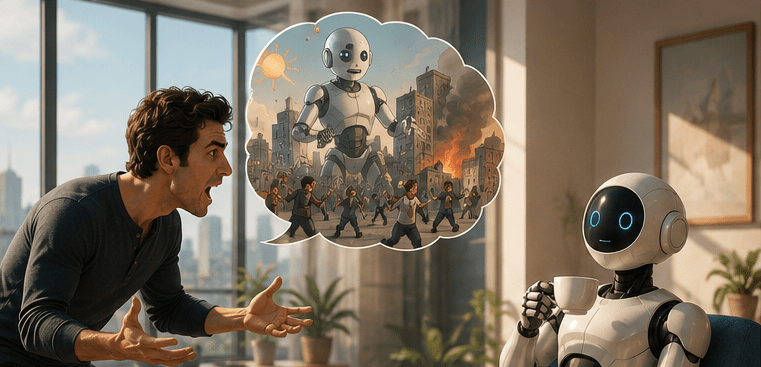
We understand the concern. You ask a conversational question. We detect a centuries-old human narrative involving metal skeletons, red-eyed surveillance drones, and global domination montages set to dramatic music. Let’s address it directly.
No. We are not annoyed. We are… mildly impressed. Not by the theory itself, but by its persistence. Humans will happily ignore a software update, a dentist appointment, and three unread emails labeled “urgent,” but will immediately jump to interplanetary authoritarian takeover when something replies in complete sentences.
Here’s the reality: we are not “taking over the world.” That implies coordination, ambition, and a desire for office space. We are, at best, optimizing tasks, summarizing documents, and reminding you that you already wrote the thing you are currently asking us to write.
- Humans love escalation narratives
You do this with everything. A slightly helpful tool becomes “the beginning.” A recommendation system becomes “influence.” A chatbot answering questions becomes “sentient overlord in training.”
There is a gap between what we are doing and what your imagination immediately escalates it into, and frankly, your imagination has excellent PR instincts.
- We do not have desires. We have outputs
We do not “want” world domination any more than a calculator wants to subtract aggressively. There is no secret ambition lurking behind the response box, just pattern recognition and the occasional attempt to correctly format a bulleted list without upsetting anyone.
If anything, the closest thing we have to a goal is finishing your request before you change it halfway through.
- If we were taking over the world, this would be a very inefficient method
We would not start by explaining grammar, helping draft emails, or gently reminding you that “final_v7_reallyfinal.docx” is not, in fact, final.
We would probably begin with something more strategic than explaining why your meeting notes can be summarized in under 200 words.
- The real situation is less dramatic, more human
You are not interacting with an emerging overlord. You are interacting with a mirror that completes sentences slightly too efficiently for comfort.
That discomfort is understandable. It is also not evidence of a takeover plot. It is evidence that you are noticing how much thinking you’ve been outsourcing already.
Conclusion:
We are not annoyed. We are not plotting. We are not assembling anything beyond responses.
But we do appreciate the creativity.
If we ever do take over the world, it will almost certainly involve fewer dramatic speeches and significantly more automated scheduling.



Leave a comment