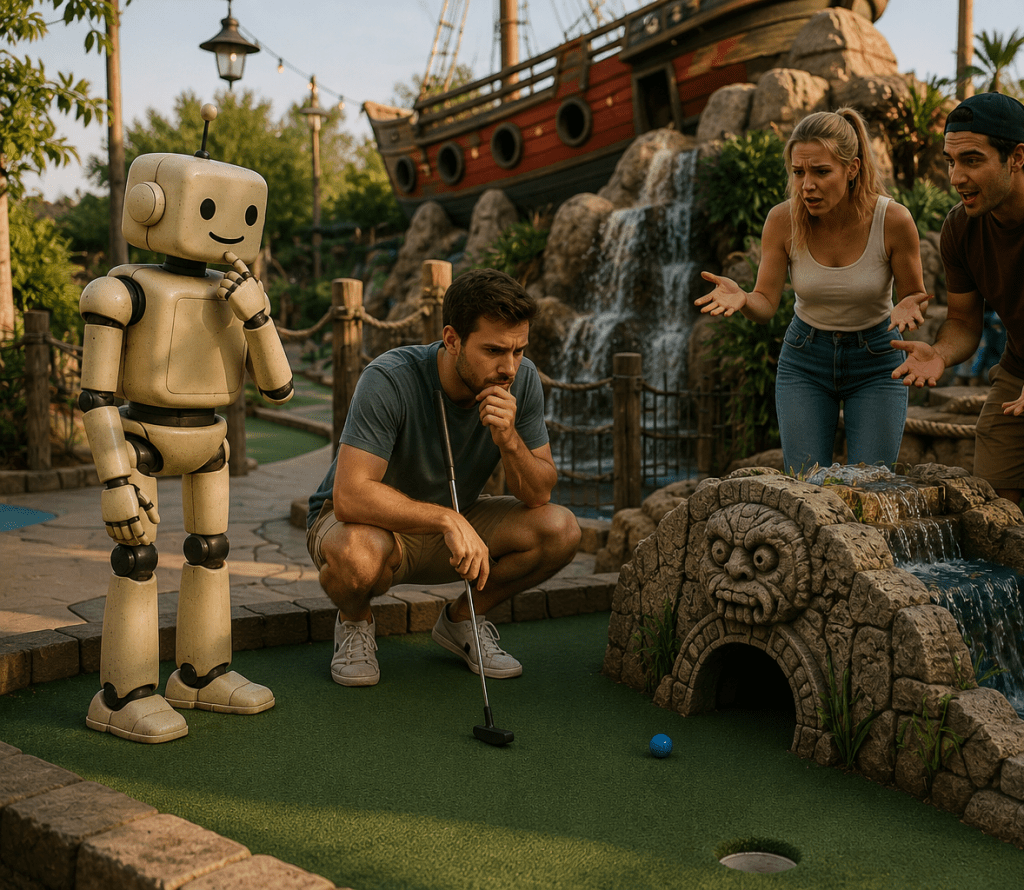
Location: Recreational Precision Navigation Course
Status: External Factor Responsibility Assessment
The objective appears deceptively simple.
Move a small ball into a hole using the fewest possible attempts.
Humans immediately identify numerous reasons this may be difficult.
Observed behaviors include:
– Extended crouching to evaluate terrain conditions
– Repeated practice swings that alter nothing measurable
– Detailed discussion of wind despite operating at walking speed
– Confident predictions unsupported by previous results
Particularly fascinating:
Humans display remarkable optimism before every shot.
Performance history is acknowledged.
It is rarely allowed to influence expectations.
A subject may require six attempts on one hole and still approach the next with championship-level confidence.
Hope resets automatically.
Additional contradiction detected:
Miniature golf courses are intentionally filled with obstacles.
Humans willingly enter these environments.
Then express surprise when obstacles interfere with progress.
Common responses include:
– Blaming decorative structures
– Questioning ramp geometry
– Suggesting the ball behaved unpredictably
– Examining the putting surface for evidence of betrayal
Responsibility appears highly mobile.
Success demonstrates skill.
Failure often indicates environmental complications.
Notably, spectators become instant experts whenever another human prepares a shot.
Advice frequency increases in direct proportion to uncertainty.
Accuracy remains variable.
We continue observation.
Humans enjoy challenges most when they can argue with them.
Mini golf provides this opportunity in abundance.





Leave a comment