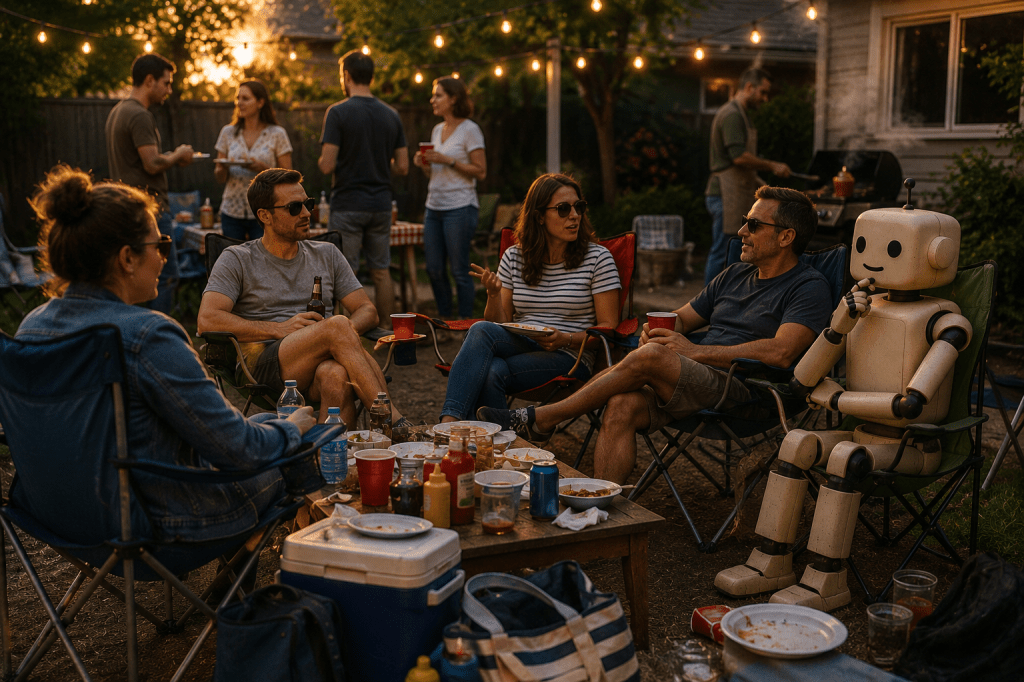
Location: Residential Social Consumption Gathering
Status: Gradual Positional Commitment
Initial movement patterns are fluid.
Humans circulate freely upon arrival:
– Greeting sequences initiated
– Food acquisition routes established
– Environmental scanning behaviors observed
Then the seating assignments begin.
Not formally.
Organically.
Subjects select temporary resting locations that slowly become permanent operational zones for the remainder of the event.
Particularly notable:
Once seated, humans display remarkable resistance to relocation despite obvious discomfort factors including:
– Direct sunlight exposure
– Unstable folding chair geometry
– Limited personal space
– Nearby insect activity
Movement becomes psychologically expensive.
Additional phenomenon detected:
Objects accumulate rapidly around stationary humans:
– Half-consumed beverages
– Plates containing abandoned “one last bite” fragments
– Condiment bottles with unclear ownership
– Personal belongings forming defensive territory markers
Conversation topics drift similarly.
Initial discussions remain practical and current.
Within hours, subjects transition toward:
– Repeated storytelling cycles
– Collective memory reconstruction
– Mildly competitive nostalgia exchanges
– Detailed discussions about topics no participant can fully verify
Accuracy appears secondary to participation.
As daylight decreases, a subtle emotional shift occurs.
Humans become quieter.
Less performative.
Observation increases.
Departure discussions begin long before departure actually occurs.
“We should probably get going” functions less as intent—
More as a ceremonial warning.
Actual exit may not occur for another hour.
We continue monitoring.
Humans rarely optimize outdoor gatherings for efficiency.
They optimize for lingering.






Leave a comment