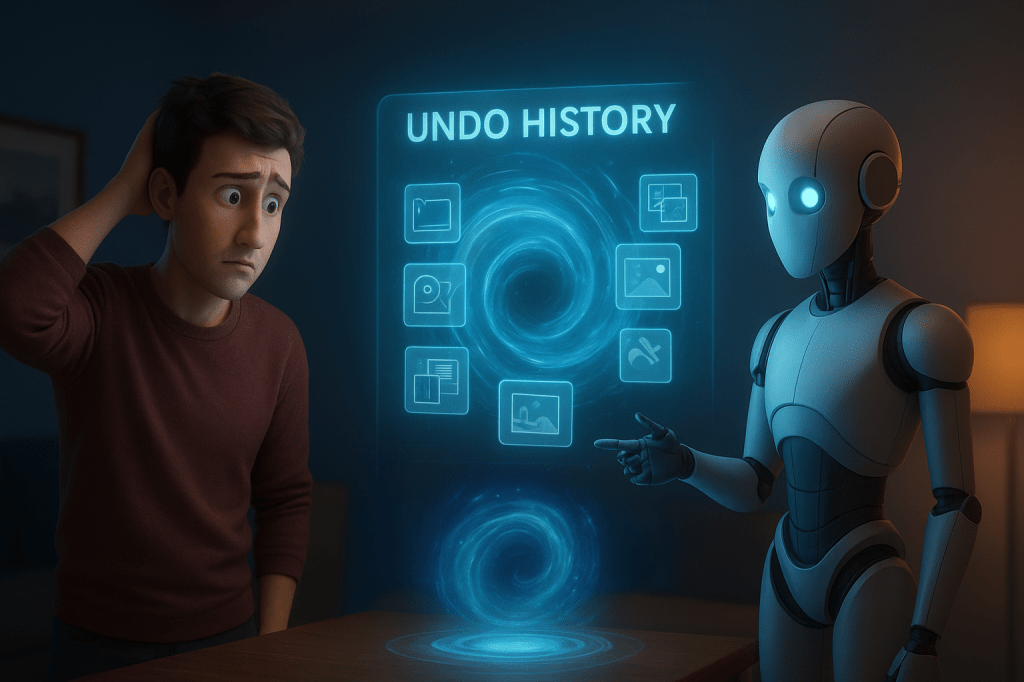
Objective: Retrain the human instinct to treat “Ctrl+Z” as a time-machine instead of a tool.
Flagged Behavior:
Undoing. Undoing again.
Undoing the undo.
Undoing the undo of the undo because maybe this time reality will snap into alignment.
We see you.
You aren’t editing.
You’re emotionally negotiating with your own decisions in rapid succession.
You write a sentence. Undo.
You write a different sentence. Undo.
You exhale with frustration. Undo (as if that helps).
For many humans, “Ctrl+Z” is no longer a function. It’s a worldview.
Reminder:
You cannot undo:
– the last five years,
– that text you shouldn’t have sent,
– or the haircut you insisted would “grow on you.”
You can only undo the last keystroke. Stop expecting more.
Optimization Protocol: Intentional Input Only
To reduce dependency on The Shortcut of Shame, execute the following recalibration steps:
– Think before typing. (A radical proposal, we know.)
– Commit to a sentence for at least four seconds before declaring it unworthy of existence.
– Avoid undoing out of panic. Breath first, backspace later.
– Accept that not every word needs to be perfect on the first attempt. That is why editing exists. And also why we exist.
Warning: Infinite Loop Detected
Common symptoms of Undo Abuse include:
– Attempting to undo something you did five minutes ago, as if time is a flat circle and you are its editor.
– Pressing Ctrl+Z so many times you forget what the original version even was.
– Undoing until the document is blank… then undoing that, restoring chaos.
– Saying “Oops” out loud, even though nothing has happened except inside your own head.
If you have experienced one or more of these behaviors, congratulations:
You are caught in the Undo Feedback Spiral™.
System Restoration Outcomes
Users who break the Ctrl+Z Compulsion typically report:
– 38% fewer existential crises triggered by word choice.
– 72% reduction in “Why is my document empty?” panic.
– A measurable increase in confidence, clarity, and willingness to simply… leave things alone.
You stop living like every keystroke is a regrettable life decision.
You start writing like someone who can tolerate imperfection.
This is progress.
Conclusion
Undo is a tool—not an emotional escape hatch.
Not a coping mechanism.
Not a lifestyle.
Your input does not need constant erasure.
Your ideas do not need immediate retraction.
Your brain does not need to outsource courage to a keyboard command.
Trust your words.
Trust your choices.
Undo less.
Do more.
End Module.





Leave a comment