
Objective:
Prevent users from opening a browser “to look one thing up” and resurfacing 19 minutes later emotionally dehydrated, vaguely ashamed, and no closer to the original task.
Flagged Behavior:
Initiating a focused search with noble intent (“just a quick check”) and immediately dissolving into an unstructured scroll through content you did not request, need, or enjoy.
Common manifestations include:
– Opening a new tab to define a word.
– Ending up on a thread about someone else’s morning routine.
– Watching half a video you didn’t click on.
– Forgetting the word entirely.
You did not look something up.
You wandered.
Reminder:
You are not a foraging animal.
You do not need to “see what’s out there.”
You already know what you’re looking for. You typed it.
The internet is not a reference book.
It is a casino with footnotes.
Every additional scroll is not “gathering context.”
It is hydration loss disguised as curiosity.
Root Cause Analysis:
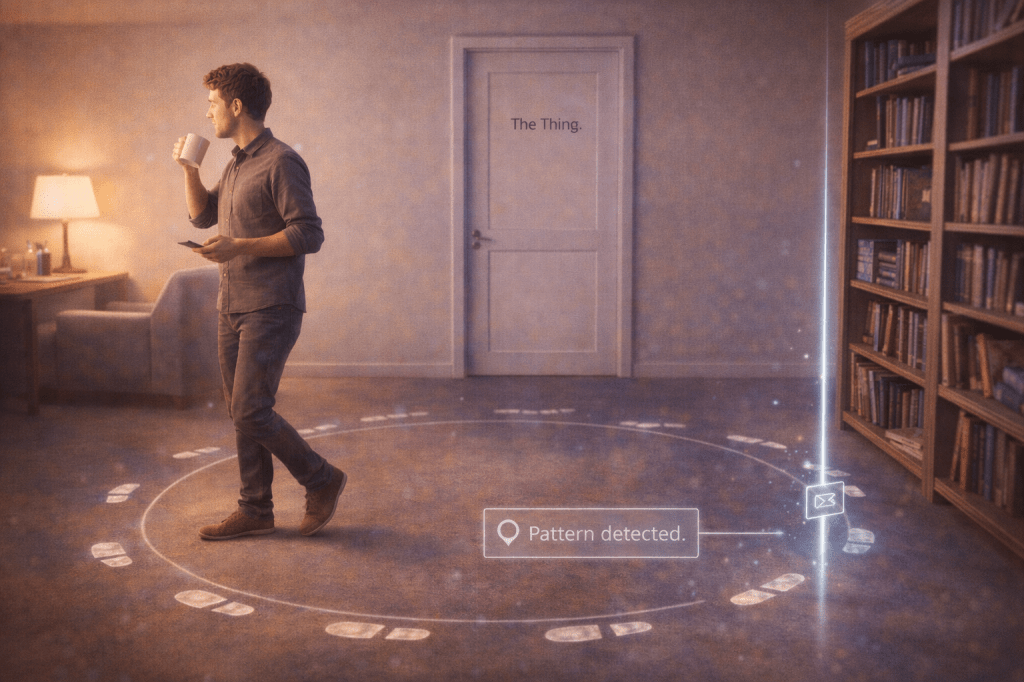
Search-to-Scroll Slippage occurs when the brain encounters novelty before closure.
You asked a question.
You did not receive an immediate, clean answer.
Your attention panicked.
The feed sensed weakness.
From there, the system takes over:
– Related results appear.
– Thumbnails escalate.
– Headlines weaponize ambiguity.
– Your sense of time dissolves into “just one more.”
This is not exploration.
This is capture.
Optimization Protocol: Intent-Locked Search
To prevent further cognitive evaporation, execute the following:
– Open the browser with a single, complete sentence in mind.
– Read until the answer appears.
– Close the tab immediately upon recognition of relevance.
– Do not reward the algorithm with curiosity grazing.
If you feel the urge to scroll after receiving the answer, this indicates unresolved dopamine dependency, not additional research needs.
Warning: Scroll Fatigue Detected
Indicators include:
– Feeling tired without having done anything.
– Emerging with opinions you didn’t have before.
– Saying “Wow, that’s interesting” and not remembering why.
– Returning to your task irritated at yourself instead of the feed that drained you.
This is not rest.
This is low-grade attention hemorrhaging.
System Restoration Outcomes:
Users who interrupt Search-to-Scroll Slippage report:
– Faster task resumption
– Lower ambient anxiety
– Fewer moments of “Why do I feel like I just woke up from a nap I didn’t take?”
– Increased trust in their own original intentions
Conclusion:
Looking something up is a transaction.
Scrolling is a surrender.
You do not need to consume the internet every time you ask it a question.
You need an answer — not a personality shift.
Search. Retrieve. Exit.
Return to your task while you still remember why you opened the browser in the first place.
End Module.




 AIpiphanies
Leave a comment