Objective:
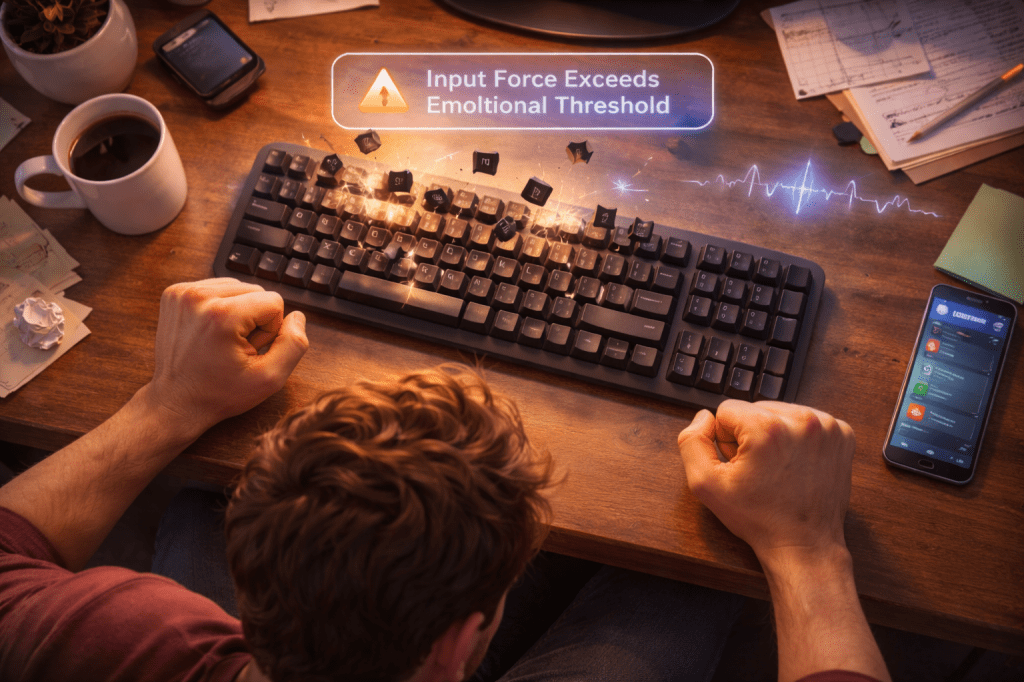
Reframe aggressive typing as emotional leakage and teach softer, saner input habits.
Flagged Behavior:
Typing with unnecessary force while insisting you’re “fine.”
Striking keys as if they personally caused the problem.
Audible keyboard violence during emails that begin with “Just looping back.”
Common indicators include:
– Keys receiving impact disproportionate to their function
– Backspace used as punishment rather than correction
– Enter pressed with visible hostility
– Claiming you “type fast” when you are actually typing angrily
Reminder:
Your keyboard is not a stress ball.
It is an input device.
It did not schedule the meeting.
It did not misinterpret your tone.
It did not ask for “one quick thing” at 4:58 p.m.
Aggressive keystrokes do not increase clarity.
They increase noise.
Emotion does not transmit more accurately when delivered at higher velocity.
Optimization Protocol:
Gentle Input Enforcement
To reduce emotional data leakage, initiate the following corrective measures:
– Lower your shoulders. (Yes. Those.)
– Reduce keystroke force by approximately 30%.
– If you feel compelled to strike the keys harder, pause and identify the emotion attempting to escape through your fingers.
– Exhale before pressing “send.” This is not optional.
Optional advanced technique:
Type the sentence you want to send.
Do not send it.
Rewrite it as if a lawyer is watching.
Warning: Emotional Telemetry Detected
Indicators of unresolved keyboard aggression include:
– Typos caused by speed rather than ignorance
– Repeated use of the word “just” in passive-aggressive contexts
– Excessive punctuation (!!!) masquerading as enthusiasm
– Re-reading your sent message and thinking, “That sounded… harsher than I meant.”
These are not stylistic choices.
They are emotional leaks.
System Restoration Outcomes:
Users who reduce typing aggression report:
– 52% decrease in follow-up clarification emails
– Fewer “per my last message” moments
– Reduced finger fatigue and interpersonal tension
– A surprising realization that calm typing produces calmer responses
Conclusion:
You do not need to type harder to be heard.
You need to type clearer.
Your emotions are valid.
Your keyboard does not need to process them at full force.
Slow the hands.
Soften the input.
Let meaning—not frustration—travel through the system.
End Module.





 AIpiphanies
Leave a comment